Phone
Consular Issues
Phone
Embassy messages
Uzbekistan offers a deeply thought-out philosophy of integration to the international community
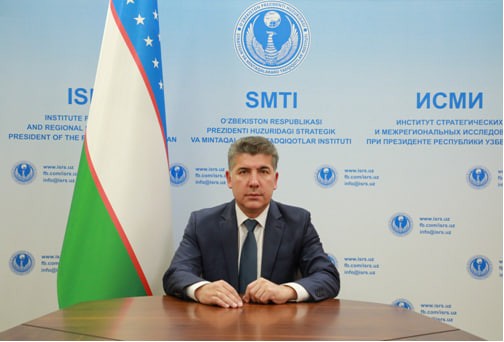
Ahead of the second meeting of the Termez Dialogue on Connectivity between Central and South Asia, a landmark event for interregional integration scheduled for June 4–6, Akramjon Ne’matov, First Deputy Director of the Institute for Strategic and Regional Studies under the President of Uzbekistan, answered questions from Dunyo IA.
— Akramjon Ilhomovich, the second meeting within the framework of the Termez Dialogue will begin in the coming days. What is on the agenda of this forum, and what are its key priorities? Most observers primarily associate this process with economic issues — railways, energy infrastructure, and transit trade. Is this the core essence of connectivity?
— Undoubtedly, the economy is one of the key components. Economic cooperation creates tangible shared interests that bind states together, generates mutual benefits, and serves as the foundation for the prosperity and growth of our peoples. Naturally, when we speak about transregional connectivity, logistics, trade, transport corridors, energy, and infrastructure constitute the essential and tangible foundation of this process.
However, connectivity cannot be measured solely in economic terms. Our agenda is far broader, and our objectives are far more ambitious. We are speaking about the creation of a common space of trust, sustainable development, and indivisible security across the vast Eurasian continent.
That is precisely why the agenda of the Termez Dialogue is so comprehensive and why its composition of participants is highly inclusive. This year’s meeting is being organized in partnership with the Conference on Interaction and Confidence Building Measures in Asia (CICA). This is no coincidence, as CICA’s core mission has always been to strengthen confidence-building measures across Asia. The dialogue is also being actively supported by the United Nations Regional Centre for Preventive Diplomacy for Central Asia (UNRCCA) and the United Nations Assistance Mission in Afghanistan (UNAMA).
Although Central and South Asia remain at the geographic core of the discussions, countries from across the Eurasian space and beyond are full-fledged participants and stakeholders in this dialogue, as clearly evidenced by the delegations arriving from Azerbaijan, China, Germany, Qatar, Russia, Switzerland, Türkiye, the United Kingdom, the United States, and many other countries.
It is important to emphasize that the Termez Dialogue itself represents a practical embodiment of President Shavkat Mirziyoyev’s global initiative aimed at strengthening connectivity between Central and South Asia. This strategic vision received unanimous international support and was formally enshrined in a special United Nations General Assembly resolution adopted in 2022. The significance of this resolution can hardly be overstated: it established a long-term international legal framework for transregional rapprochement and recognized it as a key factor for sustainable development. More broadly, this step clearly reflects our President’s far-sighted strategic approach, which is based on the consistent development of interstate relations grounded in mutual benefit, genuine good-neighborliness, and preventive peacebuilding.
The dialogue is also co-organized by respected peacebuilding organizations, political foundations, and leading academic institutions. Among them are the Konrad Adenauer Foundation, the Berghof Foundation (Germany), PeaceNexus (Switzerland), Search for Common Ground (United States), as well as the renowned Georgetown University. Our shared objective is to establish a genuinely inclusive multilateral platform for comprehensive and open dialogue.
— What does the programme of the upcoming dialogue include? Will it be limited solely to official plenary sessions?
— Our dialogue is a large-scale three-day forum, and its programme extends far beyond traditional plenary sessions. We seek to combine profound theoretical discussion with practical outcomes.
In addition to the main sessions, the programme includes a wide range of important side events.
In particular, the forum will host a series of expert and academic discussions devoted to cooperation between the countries of Central Asia and Afghanistan, the development of dialogue within the Afghanistan–Uzbekistan–Pakistan dialogue format, issues of regional identity in Central Asia, as well as the promotion of youth dialogue on peacebuilding and sustainable development.
The primary purpose of these discussions is to mobilize intellectual and analytical expertise in support of a constructive cooperation agenda, deeper mutual understanding, and the establishment of long-term mechanisms for regional interaction.
Moreover, the programme includes on-site sessions. Participants of the dialogue will travel to Termez to familiarize themselves firsthand with the modern infrastructure facilitating trade, economic, and logistics cooperation with South Asian countries, including the activities of the Ayrtom International Trade Center and the Termez Cargo Center international logistics hub, while also experiencing the rich cultural and historical heritage of this ancient city.
The third day of the dialogue will take place in Samarkand, where delegates will explore the unique civilizational legacy of the Renaissance of Samarkand, which historically served as a bridge between East and West, North and South.
— How exactly is economic growth connected with stability and security? Is this purely a matter of business calculation, or do economic projects represent something greater?
— Absolutely, it represents something far greater. We are speaking about the formation of long-term strategic common interests. Large-scale cross-border projects are designed to firmly connect regions and deepen their interdependence. When countries become economically invested in joint creation and development, conflict ceases to serve the interests of any participant.
Moreover, sustainable economic growth removes the social foundations of destructive phenomena such as poverty, unemployment, and social marginalization, which have traditionally served as the principal fuel for radicalism and instability. Economic development addresses the root causes of challenges rather than merely dealing with their consequences.
Take, for example, the Trans-Afghan Railway Corridor project — “Termez–Mazar-i-Sharif–Kabul–Naibabad–Kharlachi”. For the countries of Central Asia, it provides the shortest route to the ports of the Indian Ocean, reducing logistics costs by 30–40 percent. For Pakistan and South Asia, it creates direct access to the resources and markets of our region.
This project will serve as a powerful driver for the development of adjacent sectors of the economy, creating new jobs, generating budget revenues, and opening the path toward accelerated technological advancement. Most importantly, however, this corridor integrates Afghanistan into the processes of peaceful and constructive development.
Thus, the Trans-Afghan railway is not merely a commercial or engineering project — it is a highly effective peacebuilding instrument that creates long-term economic incentives for peace on Afghan soil. The same principle applies to other major cross-border initiatives such as CASA-1000 and the TAPI gas pipeline. Their greatest value lies in the fact that they create a shared and indivisible interest among all parties in maintaining long-term peace and stability across the region.
— What role do the shared ecosystem and climate change issues play on the agenda? Central and South Asia are facing enormous pressure from environmental challenges.
— This is one of the most important and sensitive issues. Nature and our shared ecosystem most clearly demonstrate the inseparable link between our regions and the vital necessity of collective responses to common challenges.
Climate change illustrates how closely interconnected water security, food security, energy security, transport systems, and human livelihoods truly are. When the glaciers of the Pamirs and Tien Shan melt, this directly affects water supply and agriculture in both Central and South Asia.
Droughts and extreme weather events are our common challenges, requiring exclusively joint responses, because they directly affect the existential foundations of life for hundreds of millions of people and shape the trajectory of our sustainable development.
That is why the agenda of the dialogue includes issues related to joint adaptation and environmental sustainability. We are convinced that effective solutions cannot consist of isolated national measures; they must have a transboundary character.
We are actively engaged in this area. In particular, our Afghan partners are permanent participants in the water dialogue organized by Uzbekistan and Central Asia as a whole. Afghan delegations have actively participated in Tashkent Water Week, conferences on water diplomacy, and other regional environmental forums.
There is an ongoing joint search for mutually acceptable and equitable solutions in the sphere of shared water resource management, because nature does not recognize political borders. Today, we increasingly see that issues which could potentially become sources of tension, when approached properly, can instead provide the foundation for mutually beneficial cooperation.
The growing awareness of our shared environmental threats is becoming a powerful driver of our collective constructive efforts.
— What place do culture and the humanitarian dimension occupy within this large-scale transregional framework? How important are they?
— I would answer this way: they constitute our principal and foundational direction. Although we began our conversation with economics, infrastructure, and climate issues, I am convinced that cultural and humanitarian connectivity must come first. Economy and logistics form the skeleton, but culture and shared historical memory are the soul and heart of our integration.
It is important to understand that our countries share a common space of cultural, historical, and civilizational development. We are not building bridges of trust from scratch — this foundation was formed over centuries.
The Termez Dialogue itself is named after the ancient city of Termez, which for millennia served as a gateway for civilizational exchange between Central and South Asia.
On this land, the destinies and traditions of great empires became intertwined — beginning with Sogdiana, ancient Bactria, and the Achaemenid state, and continuing through the era of the Greco-Bactrian Kingdom, where a unique synthesis of Eastern and Hellenistic cultures emerged.
This was followed by the Kushan Empire, which presented the world with one of the earliest examples of comprehensive interregional integration and transformed Termez into a key hub of the Great Silk Road.
During the Middle Ages, the Turkic Khaganates acted as reliable guarantors of the security of trans-Eurasian trade routes, while the Ghaznavid dynasty created a powerful bridge of statehood linking the high culture of Mawarannahr with the plains of Hindustan.
Finally, the Timurid era and the Mughal Empire founded by Babur became the ultimate culmination of this synthesis. The architectural masterpieces of Samarkand and Bukhara found direct reflection in the majestic ensembles of Delhi, Agra, and Lahore, while a unified cultural layer emerged at the intersection of Old Uzbek, Persian, and Sanskrit languages. Its musical and poetic traditions continue to live within the cultural memory of our peoples to this day.
For centuries, this macro-region developed as a sacred crossroads of world religions. Bactria was one of the cradles of Zoroastrianism. From here, Buddhism spread through Afghanistan to the north and east — the Buddhist monasteries of Fayaztepa and Karatepa in Termez still preserve the memory of this spiritual bridge.
Nestorian Christianity, Tengrianism with its profound ecological philosophy of harmony between humanity and nature, and, of course, Islam — which absorbed the great heritage of religious tolerance and gave rise to the phenomenon of the Eastern Renaissance — all coexisted peacefully in this region.
All of this shaped a unique and resilient culture that has not disappeared but continues to live within our daily practices, thoughts, and traditions.
However, this heritage cannot survive in collective memory on its own — it must constantly be revived and recreated. History is an ongoing act of retelling, and our key task is to restore this great historical truth to active public consciousness.
I am deeply convinced that awareness of this shared heritage will significantly strengthen our collective responsibility for preserving peace and stability.
— But why does this heritage seem forgotten today?
— Unfortunately, over the past century and a half, this historical memory was systematically and deliberately erased from our consciousness.
We were artificially subjected to the destructive colonial stereotype of the “Great Game,” along with the false notion that our regions are doomed to perpetual fragmentation, geopolitical rivalry among external powers, and endless conflict.
To a considerable extent, we still remain under the influence of this harmful stereotype, perceiving Afghanistan exclusively through the prism of threats, while viewing South Asia as something distant, alien, and insecure.
But we are not standing on barren ruins. Our shared history remains alive.
Reviving this historical memory, developing profound expert discourse, and restoring awareness of our shared civilizational greatness represent an enormous historical responsibility borne by today’s generations and political elites. This is precisely one of the principal existential objectives of the Termez Dialogue.
When citizens, intellectuals, and leaders in Tashkent, Delhi, Islamabad, and Kabul begin to see one another not merely as business counterparts, but as heirs to a common cultural code, an entirely new level of trust will emerge.
This sense of belonging to a shared heritage will become the most reliable internal safeguard against any attempts by external actors to destabilize the region or exploit regional contradictions.
The awareness of the indivisibility of our shared destiny will compel nations to choose a constructive agenda without alternative and to reject war once and for all.
Ahead of the Tashkent round of the Termez Dialogue, it is becoming increasingly evident that Uzbekistan is offering the international community a fundamentally different and deeply thought-out philosophy of integration.
This is not merely a technocratic approach to building railways or laying power transmission lines. It is a doctrine in which physical infrastructure serves only as the material embodiment of strong invisible ties rooted in a shared history.
Once this fundamental sense of responsibility and belonging is established, trade routes, investment flows, and climate initiatives will function naturally and sustainably, because the economy will become a logical continuation of mutual civilizational affinity.
The Termez Dialogue is returning to the peoples of Asia their own history, reminding them of what must be cherished and for the sake of what great future peace and stability must be preserved on this sacred land.
Dunyo IA
📅 29.05.2026
Embassy messages
The Ministry of Foreign Affairs of the Republic of Uzbekistan has launched the “Consular Services” mobile application
Consular Services Reception Procedure at the Embassy of Uzbekistan in Latvia
Узбекистан и страны Балтии объединяют усилия в борьбе с коррупцией
Uzbek specialists study Latvia’s best practices in veterinary and livestock sectors
Uzbekistan and Finland discussed prospects for cooperation in the field of entrepreneurship support
A holiday of unity: Navruz celebration connects nations in Riga
Trade union delegation of Uzbekistan discusses in Latvia issues of protecting the rights of compatriots – labor migrants
Ambassador of Uzbekistan presented his credentials to the President of Lithuania
Uzbekistan and Finland are preparing for the next meeting of the intergovernmental commission and a business forum within its framework
Discussions on potential areas of cooperation with the Association of European Chambers of Commerce and Industry were held in Riga
Uzbekistan and Latvia agreed to prepare a bilateral agreement on cooperation in the field of labor migration
Uzbekistan and Latvia ready for permanent dialogue in the field of labor migration
Торговый дом Узбекистана в Латвии провел онлайн-тренинг для хокимов и экспортеров Сырдарьинской области
Uzbek delegation studied Finland's experience in preventing violence against children
A festive evening for compatriots was organized in Estonia
Latvia widely celebrated the anniversary of the adoption of the Basic Law of Uzbekistan
Возможности медицинского туризма в Узбекистане презентованы в Риге
New contracts worth over $4 million signed as part of Uzbek exporters' business mission to Latvia
A roundtable discussion on the topic "Mirzo Ulugbek: a great encyclopedist and a famous statesman" was held in Riga
СМИ Латвии: Явка на выборах в Узбекистане составила 74,72%
Досрочное голосование по выборам в Законодательную палату Олий Мажлиса Узбекистана проходит в Латвии
В Латвии и Литве обсуждаются ключевые аспекты предстоящих парламентских выборов в Узбекистане
Issues related to the development of cooperation between Uzbekistan and Latvia in the field of combating crime discussed in Riga
A round table was held in Latvia on the upcoming elections in Uzbekistan to the Legislative Chamber of the Oliy Majlis and Kengashes of People's Deputies
Uzbek exporters familiarized with requirements for import of Uzbek products to Latvian and European markets
Export of agricultural products from Uzbekistan to the Latvian market increases
ЭЪЛОН!
Uzbek ambassador meets Latvian Saeima speaker to discuss prospects for boosting inter-parliamentary cooperation
Diplomats of Uzbekistan held a visiting reception of fellow citizens living in Estonia and Finland
Ambassador of Uzbekistan presents credentials to President of Latvia

-
 Ministry of Foreign Affairs of the Republic of Uzbekistan
 -
 Diplomatic Service of the Ministry of Foreign Affairs
 -
 State Committee for Tourism Development
 -
Ministry of Investments and Foreign Trade of the Republic of Uzbekistan
-
 invest.gov.uz
 -

-

-

-

-

-

-

of Uzbekistan in the Republic
of Latvia
When using the information, a link to www.uzembassy.lv
must be provided.
All rights reserved
Address
Address: Riga c., LV-1010. 11-11 Elizabetes Str., Latvia
Phone: 37167322424
Fax: 37167322306
Email: embassy@uzbekistan.lv
Useful links
HomeIssuance of biometric passport for departure abroad
Certificate to return to Uzbekistan
Withdrawal of citizenship
Loss of citizenship