Phone
Consular Issues
Phone
Science and Education


We recommend
UZBEKISTAN AND BELARUS: A NEW STAGE OF STRATEGIC COOPERATION IN VOCATIONAL EDUCATION
📅 10.07.2026
Today, the vocational education system is no longer limited to the transfer of knowledge alone; it has entered a fundamentally new stage focused on preparing learners for real working environments. International experience demonstrates that the most effective model for developing a highly qualified workforce is the balanced integration of theoretical knowledge with practical skills. Strengthening cooperation between educational institutions and industrial enterprises enables young people to acquire professional competencies through hands-on training during their studies, work with modern technologies, and gain a deeper understanding of the actual demands of the labour market.
As repeatedly emphasized by the President of the Republic of Uzbekistan, young people should be educated as a generation of modern professionals who keep pace with the times, are prepared for future challenges, and possess advanced knowledge. His statement, “The future belongs to representatives of new professions equipped with modern knowledge,” most accurately reflects the essence of the large-scale reforms being implemented in Uzbekistan’s education sector. For this reason, cooperation between Uzbekistan and the Republic of Belarus in the field of vocational education has become one of the strategic priorities of bilateral relations in recent years.
Against the backdrop of rapid industrialization and the digital transformation of both countries’ economies, the training of highly qualified specialists has become one of the key priorities of state policy. The Republic of Belarus’s extensive experience in vocational education, its modern educational and methodological framework, and its training model closely integrated with industry have attracted considerable interest from Uzbekistan. At the same time, Uzbekistan’s young and dynamic demographic potential provides a solid foundation for the effective adaptation and further development of this experience. As a result, the education systems of the two countries have established a mutually beneficial, long-term strategic partnership focused on practical outcomes.
The foundations of this cooperation were laid during 2018–2019, when the first agreements aimed at expanding collaboration in education and workforce development were signed. Partnership relations were established between a number of higher and vocational educational institutions in Uzbekistan and leading universities, colleges, and technical institutions in the Republic of Belarus. Through the establishment of joint faculties, academic exchange programmes, and collaborative educational projects, bilateral cooperation reached a qualitatively new level.
A significant milestone was the entry into force, in 2020, of the Intergovernmental Agreement on the Mutual Recognition of Educational Qualifications and Training Documents. The implementation of this agreement created new opportunities for graduates of educational institutions in both countries, significantly enhanced the attractiveness of joint educational programmes, and further strengthened the integration of the education systems of Uzbekistan and Belarus.
In the following years, cooperation advanced to a new stage of development. In particular, during the official visit of the President of the Republic of Belarus to Uzbekistan in February 2024, a dedicated Roadmap was signed to further deepen cooperation in vocational education. The document established specific objectives for training specialists in modern occupations, integrating educational programmes, enhancing the professional development of teaching staff, and strengthening the linkage between the education system and industry.
On 29–30 April 2024, the First Uzbekistan–Belarus Vocational Education Forum was held in Minsk. The Forum became an important platform for strengthening practical cooperation between the vocational education systems of the two countries, facilitating the exchange of best practices, and promoting the development of new joint initiatives.
The Forum brought together representatives of vocational education institutions, industrial enterprises, and Centres of Competence, who identified promising areas for further cooperation.
In recent years, the strategic partnership between Uzbekistan and the Republic of Belarus in the field of vocational education has reached a fundamentally new level. Today, this cooperation extends far beyond individual projects or short-term initiatives and has evolved into a systematic model of collaboration aimed at achieving the long-term development objectives of both countries. A significant milestone in this process was the adoption of the 2024–2025 Action Plan (Roadmap), which has provided new momentum to bilateral cooperation and has become an important instrument for the modernization of the vocational education system.
Within the framework of the Roadmap, a range of coordinated measures is being implemented to strengthen cooperation between the education system and industry, prepare specialists whose competencies meet labour market demands and international standards, and introduce modern pedagogical approaches. These measures include the development of the material and technical infrastructure of vocational education institutions, the modernization of educational programmes, the continuous professional development of teaching staff, and the enhancement of practical training for learners.
In particular, fourteen core vocational education institutions in Uzbekistan, designated to establish modern Vocational Training Centres, have established direct partnerships with the leading Centres of Competence of the Republic of Belarus. This cooperation includes the exchange of teaching and methodological resources, the participation of teachers and vocational instructors in professional development programmes, the organization of joint seminars and training sessions, and the introduction of advanced educational technologies.
This model of cooperation facilitates the effective integration of international best practices into Uzbekistan’s vocational education system, enhances the efficiency of the educational process, improves the quality of practical training, and raises overall educational standards. As a result, learners strengthen their professional competencies, develop practical skills in the use of modern technologies, and improve their competitiveness and employability in the labour market. At the same time, this form of cooperation promotes the broader adoption of international quality standards, strengthens the linkage between education and industry, and enhances the effectiveness of training highly qualified specialists for various sectors of the economy.
Particular attention has been devoted to the scientific and methodological support of this cooperation. To this end, V. N. Golubovsky, Rector of the Republican Institute of Vocational Education of the Republic of Belarus (RIPO), has been appointed as an Adviser to the Ministry of Higher Education, Science and Innovation of the Republic of Uzbekistan. His contribution plays a significant role in the development of educational programmes, the implementation of international standards, and the coordination of joint initiatives, thereby enhancing the quality and effectiveness of the ongoing reforms.
The practical outcomes of this cooperation are already being directly reflected in the educational process. Taking into account the evolving needs of the labour market and the growing demand of industrial enterprises for highly qualified specialists, integrated joint educational programmes covering 11 of the most in-demand occupations and specializations were developed for the 2024/2025 academic year.
These programmes combine the Republic of Belarus’s advanced experience in vocational education with the practical needs of Uzbekistan’s real sector of the economy. This approach contributes to the modernization of educational content, strengthens the integration of theoretical knowledge with practical skills, and ensures that the learning process closely reflects real industrial working environments.
At present, these programmes are being successfully implemented on a pilot basis in 13 vocational education institutions, where their effectiveness is being systematically monitored and continuously refined. To date, a total of 834 students are enrolled in these programmes. In addition to acquiring a solid foundation of theoretical knowledge, they gain practical experience with modern production technologies, automated systems, digital management processes, and real-world industrial problem-solving.
Furthermore, students participate in elements of dual education, workplace-based training, and internships at operating enterprises. This approach strengthens their professional competencies, fosters independent decision-making, and prepares competitive specialists capable of succeeding in both the national and international labour markets.
The implementation of these educational programmes therefore provides a strong foundation for the continued development of a vocational education system that prepares modern, highly qualified, and innovation-oriented professionals capable of meeting the evolving needs of various sectors of the economy.
One of the key factors in ensuring the quality of vocational education is the knowledge, professional expertise, and practical experience of teaching personnel. Accordingly, within the framework of bilateral cooperation, particular emphasis is placed on strengthening the capacities of teachers, vocational training instructors, and educational administrators, while creating opportunities for them to study and adopt international best practices.
During 2024–2025, a total of 46 teachers, vocational training instructors, and senior managers from vocational education institutions in Uzbekistan participated in specialized professional development programmes organized in the Republic of Belarus. In particular, during study visits conducted on 12–19 August 2024 and 31 March–7 April 2025, participants gained comprehensive insight into the activities of the Republican Institute of Vocational Education (RIPO) and 53 Centres of Competence across Belarus.
The professional development programmes introduced participants to modern pedagogical technologies, competency-based approaches to education, effective methods for organizing vocational training, mechanisms for integrating digital technologies into the educational process, and contemporary approaches to assessing learners’ professional competencies.
Participants also studied the operations of leading vocational education institutions in Belarus, including their models for integrating education with industry, as well as their experience in utilizing modern training workshops, laboratories, and industrial learning facilities.
During the study visits, the Uzbek delegation visited the EcoTechnoPark–Volma Resource Centre, the Industrial and Pedagogical College, the Minsk State Auto-Mechanical College, the Minsk State Radio Engineering College, the Minsk State College of Railway Transport, the Orsha College of Railway Transport of the Belarusian State University of Transport, the Minsk State College of Printing, the Minsk State College of Fashion Industry, the Smilovichi State College, and the Centres of Competence established within these institutions.
During these visits, participants explored state-of-the-art educational infrastructure, internationally equipped laboratories and production workshops, the organization of practical training, and the innovative technologies applied throughout the educational process.
Teachers also took part in practical training sessions, where they examined effective approaches to developing learners’ professional competencies, creating learning environments that closely replicate real industrial conditions, and applying modern mechanisms for assessing the quality of vocational training.
In addition, more than 30 online and in-person seminars, master classes, roundtable discussions, and scientific and practical events have been organized to promote the exchange of experience, strengthen pedagogical cooperation, and discuss innovative methodological approaches. During these events, experts shared best practices in teaching vocational disciplines, discussed modern approaches to assessing learners’ theoretical knowledge and practical skills, and developed practical recommendations for integrating innovative technologies into the educational process.
Practical cooperation between the Republic of Uzbekistan and the Republic of Belarus in the field of vocational education continues to develop dynamically, reaching a new level of institutional partnership, expanding professional exchange, and creating a solid foundation for the implementation of joint initiatives.
In March 2025, negotiations were held on organizing study visits for teachers and vocational training instructors to the Republic of Belarus, as well as on involving Uzbekistan’s continuing professional education institutions in international cooperation. As a result of these discussions, partnership relations were established between three additional educational institutions.
In particular, cooperation agreements and implementation roadmaps were signed between the Tashkent Transport Technical School and the Minsk State College of Railway Transport; the Tashkent Publishing and Printing Technical School and the V. Z. Khoruzhey Minsk State College of Printing; and Khanka Polytechnic Technical School No. 2 and the Smilovichi State College.
The agreements provide for the professional development of teaching staff, the exchange of educational and methodological expertise, the joint development of educational programmes, the introduction of modern teaching methods, and the enhancement of learners’ practical training through the implementation of a number of promising joint projects.
One of the key priorities of bilateral cooperation is the further improvement of coordination mechanisms between the vocational education systems of the Republic of Uzbekistan and the Republic of Belarus. To this end, on 19 August 2025, the Institute for the Development of Vocational Education, together with the Republican Institute of Vocational Education of the Republic of Belarus (RIPO), held an online meeting of the Joint Council.
During the meeting, participants comprehensively reviewed the implementation of the Roadmap for the Development of Cooperation in Vocational Education for 2024–2025, signed between the Ministry of Higher Education, Science and Innovation of the Republic of Uzbekistan and the Ministry of Education of the Republic of Belarus. The participants discussed the progress achieved in implementing the planned activities, assessed the results accomplished to date, and identified priority areas for future cooperation.
It was emphasized that the projects implemented within the framework of bilateral cooperation are contributing to the modernization of the vocational education system in line with contemporary requirements, strengthening the integration of education with industry, and creating favourable conditions for the preparation of highly qualified specialists who meet international standards.
One of the central issues discussed during the meeting was the approval of seven new educational programmes for vocational occupations, developed on the basis of the educational standards of the Republic of Belarus for the 2025–2026 academic year. Experts reviewed the content of these programmes, discussed mechanisms for their effective implementation within the educational process, and considered proposals to further expand the practical training component.
As highlighted during the discussions, these programmes are designed not only to strengthen learners’ theoretical knowledge but also to develop the practical competencies required for successful employment in modern industrial environments. Their implementation will significantly expand opportunities for preparing competitive specialists equipped with advanced technologies and capable of meeting the evolving demands of the labour market.
The meeting also reviewed prospective areas for further cooperation. In particular, discussions focused on expanding the number of joint educational programmes, enhancing the professional development of teachers and vocational training instructors, updating teaching and methodological resources, and introducing international best practices into the vocational education system.
According to the participants, such a systematic approach to cooperation not only promotes the active exchange of experience between vocational education institutions in the two countries but also elevates the quality and effectiveness of vocational education to a fundamentally new level.
Another significant milestone in the development of educational cooperation between Uzbekistan and Belarus was the "Innovative Cooperation: Uzbekistan and Belarus in Higher and Vocational Education" Forum, held in Fergana on 7–11 October 2025.
This prestigious international forum served as an important platform for strengthening the strategic partnership between the education systems of the two countries. It brought together the heads of more than 20 vocational education institutions, leading experts, education policymakers, and specialists from Uzbekistan and Belarus, who shared their perspectives on the key challenges and priorities in the development of modern education.
The forum featured comprehensive discussions on contemporary trends in vocational education, digital transformation, strengthening the integration of education and industry, the implementation of innovative pedagogical technologies, and the study and application of international best practices.
Particular attention was devoted to further strengthening cooperation between educational institutions and industrial enterprises, expanding the implementation of dual education, and creating greater opportunities for learners to gain practical experience in real production environments.
At the conclusion of the forum, it was emphasized that the initiatives and recommendations put forward by the participants would contribute to the continued modernization of the vocational education system. It was also noted that cooperation between Uzbekistan and Belarus has evolved far beyond the exchange of experience and is now focused on achieving tangible practical outcomes through the implementation of new joint projects, educational programmes, and innovative approaches.
This cooperation is laying a solid foundation for preparing a new generation of highly qualified, proactive, and competitive professionals equipped with the modern knowledge and practical competencies required to support the sustainable economic development of both countries.
Cooperation between the vocational education institutions of the Republic of Uzbekistan and the Republic of Belarus is developing not only through ministerial-level dialogue, strategic meetings, and major international forums, but also through direct institutional partnerships, regular exchanges of experience, and the implementation of joint initiatives. In this regard, online seminars, conferences, and roundtable discussions have become an effective platform for cooperation among teachers, educational leaders, and experts from both countries.
For example, on 3 April 2025, the I. Schastny Grodno State Electrotechnical College, in cooperation with Zamin Polytechnic Technical School No. 1 of the Jizzakh Region, organized an online seminar entitled "A Step Towards Science."
The seminar focused on pressing socio-cultural issues facing contemporary society, the development of civic responsibility among young people, and the enhancement of patriotic education in educational institutions. During the event, experts from both countries exchanged experience on nurturing a spiritually mature generation in the context of globalization and promoting respect among young people for national traditions and universal human values.
At the conclusion of the seminar, the parties agreed to further expand cooperation in these areas, increase the number of joint activities, and establish a systematic exchange of pedagogical experience.
The next significant initiative aimed at strengthening the role of practical training in vocational education was an online conference held on 28 May 2025, bringing together teachers from the Zhirovichi State Agrarian and Technical College of the Republic of Belarus and Yangikurgan Polytechnic Technical School No. 2 of the Namangan Region.
The conference focused on contemporary approaches to organizing educational and industrial training, innovative methods for assessing the effectiveness of practical instruction, and current issues related to the patriotic education of young people.
Participants presented proposals for strengthening the integration of theoretical instruction with practical training, enhancing cooperation with industrial enterprises, and further developing learners’ professional competencies. Particular emphasis was placed on the importance of practical training that closely reflects real production environments as one of the key factors in preparing competitive specialists.
On 9 December 2025, an online meeting was held between Urgench Polytechnic Technical School No. 2 and the Minsk State College of Fashion and Industry on the theme “Civic and Patriotic Education.”
During the meeting, the participants exchanged experience on fostering civic awareness among young people, promoting respect for national values, encouraging students’ social engagement, and strengthening their sense of responsibility towards society and the state.
Representatives of the educational institutions presented their educational and extracurricular programmes aimed at developing patriotism, civic responsibility, and active citizenship among young people. The meeting marked another important step in strengthening spiritual, educational, and cultural cooperation between the educational institutions of the two countries.
All of these initiatives clearly demonstrate that cooperation between Uzbekistan and Belarus in the field of vocational education is becoming increasingly comprehensive and multifaceted. Today, this partnership extends beyond the development of educational programmes and workforce training to encompass such important areas as the moral and civic education of young people, the promotion of civic responsibility, and the strengthening of patriotic values.
Most importantly, this model of cooperation reinforces mutual trust between the educational institutions of both countries, facilitates the effective exchange of best practices, and provides a solid foundation for preparing specialists whose competencies meet contemporary international educational standards.
This is the fundamental value of the strategic partnership between Uzbekistan and the Republic of Belarus in the field of vocational education—a partnership focused on practical results, sustainable long-term development, and the continued strengthening of the human capital of both countries.
Today, cooperation between Uzbekistan and Belarus in vocational education has moved well beyond individual projects and short-term initiatives, becoming an integral component of the long-term development strategies of both nations.
In today's global environment, a country's competitiveness is determined not only by its economic performance but also by the quality of its human capital, the preparedness of its skilled workforce, and the effectiveness of its national education system. For this reason, bilateral cooperation in vocational education should be regarded as one of the most valuable investments in the future.
In the coming years, both countries intend to further modernize educational programmes in line with international standards, deepen integration with industrial enterprises, enhance practical training through the application of advanced technologies, and strengthen the innovation capacity of vocational education institutions. These priorities will contribute to the continued development of a modern, flexible, and internationally competitive vocational education system capable of meeting the evolving demands of the labour market and supporting the sustainable socio-economic development of both Uzbekistan and Belarus.
Particular emphasis will be placed on preparing specialists for high-tech industries, the digital economy, engineering, energy, agriculture, and the service sector. Joint educational programmes in these fields will remain one of the most promising areas of Uzbekistan–Belarus cooperation.
At the same time, one of the key priorities of bilateral cooperation will continue to be the professional development of teachers and vocational training instructors, the expansion of their participation in international exchange programmes, and the integration of advanced pedagogical technologies into the educational process. The success of a modern vocational education system depends largely on the professional competence, expertise, and instructional excellence of its teaching workforce. In this regard, further strengthening professional dialogue between specialists from the two countries, increasing the number of joint seminars, scientific and practical conferences, internships, and other experience-sharing initiatives will be of particular importance.
Against the backdrop of rapid digital transformation, significant opportunities also exist for cooperation in the digitalization of education, the expansion of distance learning, and the development of virtual laboratories and simulation-based learning platforms. These initiatives will not only improve the quality and accessibility of education but will also equip future specialists with the advanced digital competencies required for successful professional careers.
Looking ahead, the joint development of educational modules in such fields as artificial intelligence, robotics, automated control systems, and the green economy has the potential to open new horizons for bilateral cooperation and elevate it to an even higher level.
In addition, both countries intend to further expand cooperation among vocational education institutions at the regional level, promote the academic mobility of students and teachers, and organize joint vocational competitions, master classes, and skills championships. Such initiatives will broaden the horizons of future professionals, foster innovative thinking, and prepare specialists capable of competing successfully in the global labour market.
It should be emphasized that the true value of cooperation between the Republic of Uzbekistan and the Republic of Belarus in the field of vocational education extends far beyond the implementation of joint educational programmes or the organization of various events. Its greatest significance lies in bringing together the educational potential, academic expertise, and innovative approaches of both countries in pursuit of a common objective—the preparation of a new generation of highly qualified professionals.
Every project implemented today, every joint initiative undertaken, and every step taken within the framework of this partnership is aimed at preparing engineers, technologists, energy specialists, agricultural professionals, and skilled workers for modern industry who will shape the economy of the future.
In this sense, the strategic partnership between Uzbekistan and the Republic of Belarus in vocational education represents not only an effective mechanism for addressing the evolving demands of the labour market but also a long-term model of cooperation focused on developing the intellectual and professional potential of future generations.
There is every reason to believe that the continued development of this partnership will create new opportunities for integrating education, industry, and innovation, strengthen human capital, and contribute to the sustainable socio-economic development of both countries, where people, their knowledge, professionalism, and creative potential remain the greatest asset.
Azimjon XUSANOV,Director Vocational Education Agency
Uzbekistan–U.S. Higher Education Cooperation Enters a New Stage: Opportunities and Prospects within the C5+1 Format
📅 11.11.2025
Today one of the priority directions of Uzbekistan’s foreign policy is the expansion of strategic partnerships and the exchange of modern knowledge and scientific innovations. In this process, cooperation with the United States–especially in higher education, science, and innovation–is reaching a new level.
Under the leadership of President Shavkat Mirziyoyev, the reforms implemented in education, the state policy aimed at human capital development, and the integrated “education–science–innovation” system have positioned Uzbekistan as an attractive partner on the international stage. Moreover, the C5+1 format between Central Asia and the United States is opening new opportunities for regional cooperation. Within this framework, Uzbekistan’s collaboration with American universities is already producing practical results not only in education but also in science, technology, and innovation.
Investing in Human Capital – Development through Education
One of the earliest areas of Uzbekistan–U.S. cooperation is the deep teaching of the English language and the introduction of modern pedagogical practices. Every year, dozens of experienced instructors from U.S. universities visit Uzbekistan’s higher education institutions through programs such as Fulbright, English Language Fellows Program, and English Teaching Assistants, working alongside local specialists.
In addition, under the ACCESS program supported by the U.S. Department of State, children from low-income families are given the opportunity to study English intensively for two years. Currently, these centers operate successfully under 11 universities. Each center receives a grant of around $30,000–50,000, which is used to fund teaching materials, teacher salaries, interactive excursions for students, and other educational expenses.
“American Window” and “Summer Camp”: Platforms of Inspiration
The “American Window” information center established at Karakalpak State University has become a new symbol of dialogue between the two nations in education and culture. The center houses over 150 English-language books, journals, and dictionaries, as well as brochures and guides about admission to U.S. universities. It serves not only as an information hub but also as a venue for Speaking Clubs, interactive lessons, and cultural events.
During summer holidays, the “Summer Camp” project provides schoolchildren with the opportunity to learn English through interactive classes, games, and excursions. In 2022, 150 children participated in the summer camp organized by the Samarkand State Institute of Foreign Languages, where they improved their language proficiency and developed cross-cultural communication skills.
EducationUSA and Inter-University Cooperation: Opening New Doors
The EducationUSA program under the U.S. Embassy is helping young Uzbeks pursue higher education at American universities and participate in scholarship and grant programs. Embassy representatives regularly visit Uzbek universities and hold practical seminars for students.
Furthermore, projects such as UNICEN and the Faculty Enrichment Program (FEP), implemented by the American Councils for International Education, actively support university partnerships. Over the past two years alone, 22 universities in Uzbekistan have established direct collaboration with more than 25 U.S. universities. During the 2023–2024 academic year, nine professors and researchers from Uzbekistan took part in 4–5 month professional development courses in the United States.
Webster University and New Steps Forward
Webster University in Tashkent, the first U.S. university branch in Uzbekistan, continues to expand its academic programs and increase student enrollment each year. Its success has become an inspiration for other American universities considering operations in Uzbekistan.
The Government of Uzbekistan has proposed that U.S. universities open new branches, establish dual-degree programs, and engage American professors for both short- and long-term teaching initiatives. Priority areas of cooperation include engineering, energy, medicine, architecture, and information technology (IT).
New Directions with Utah and Opportunities within the C5+1 Framework
In recent years, Uzbekistan–U.S. cooperation has taken on a new strategic dimension. In 2024 and 2025, a number of high-level meetings were held in Tashkent and Samarkand with delegations led by Stuart Adams, President of the Utah State Senate. These meetings focused on bilateral scientific and educational projects, faculty exchange, and collaboration in innovation and artificial intelligence.
Utah is one of the most economically stable states in the U.S. and is currently experiencing a shortage of professionals in engineering and medicine. Therefore, practical cooperation with Uzbek universities in these fields is mutually beneficial.
Within the C5+1 framework, the U.S. side is also supporting cooperation in the areas of science and education development, climate change, efficient water resource management, energy, and innovative economy across Central Asia.
Science and Innovation – For Shared Progress
Uzbekistan–U.S. cooperation is not limited to language education or student exchanges. Joint projects in scientific research, startups, innovation labs, artificial intelligence, and green technologies are being developed, alongside plans to organize joint scientific forums.
Currently, more than 40 universities in Uzbekistan are working with over 25 American universities and research centers under memoranda of understanding. These partnerships include faculty development programs, joint research, conferences, and academic exchanges.
The growing cooperation between Uzbekistan and the United States in higher education—especially within the C5+1 framework—will naturally move to an even higher level in the coming years. This partnership strengthens mutual trust and friendship, unlocks the potential of youth, and accelerates innovative development.
Every investment in human capital is an investment in the future. In this sense, collaboration with American universities is a crucial step for Uzbekistan in expanding access to knowledge, experience, and scientific opportunity.
Kongratbay Sharipov,
Minister of Higher Education, Science and Innovation
of the Republic of Uzbekistan
Who will study in Uzbekistan on the basis of a state grant
📅 22.06.2024
Higher education provides an opportunity for young people in Uzbekistan to take their rightful place and gain prestige in society. Supporting those who have mastered profound knowledge at previous stages of continuing education and applying an objective system of selection for this purpose will make it possible to attract the best people to the socio-economic and engineering-technological spheres: those with good basic knowledge and a strong desire for higher education, which will make the most effective use of human capital.
An important place in this is given to the state grant allocated for higher education. This factor contributes to the efficiency of training the personnel needed by the country, increasing the responsibility of higher education institutions, as well as the most objective and qualified enrollment of students in demanded areas and specialties of higher education.
At the presentation made to the President on May 6 this year, proposals for optimizing the areas of study in higher education, improving the admission and qualification systems were discussed. The importance of a more rational and fair assignment of state grants was emphasized. In this regard, it was emphasized that the selection of trained applicants with deep basic knowledge, who intend to realize their conscious goal of obtaining a certain specialty, seems to be the most promising, and the support of such persons with benefits determines the targeted training of already potential specialists. At the same time, instructions have been given to ensure transparency and efficiency of the admission process to universities, to revise the admission quotas for the new 2024/2025 academic year, to improve the qualification requirements, integrating their content with internationally recognized criteria.
At the presentation, the head of state pointed out the need to eliminate the significant discrepancy in admission quotas between bachelor's and master's degrees, as well as more rational adaptation of these levels of higher education to the needs of the modern labor market. In addition, difficulties in the formation of full-fledged qualifications for university graduates were noted, which creates certain problems in their employment. It was instructed to develop appropriate measures to form indicators of admission to universities on the basis of objective and reliable supply and demand, with the definition of real prospective needs of spheres and sectors of the economy in personnel, involving for this purpose local executive bodies, non-governmental organizations, entrepreneurs and investors. It is proposed to constructively study and work on the detailed reduction of outdated and formation of new demanded areas of higher education based on the needs of employers and the current development of economic sectors and social sphere.
Large-scale reforms carried out in our country practically in all sectors of the economy and social sphere determine a wide demand for highly qualified personnel.
As a result of consistent targeted measures, we have managed to achieve certain successes in a relatively short period of time. In particular, the total number of higher education institutions in the country has reached 211 (72 in 2016). At the same time, 67 of them are non-state universities, and 29 are branches of foreign universities. Thanks to this, it was possible to significantly expand the opportunities for higher education in the country. Thus, the total enrollment of young people in higher education in the 2023/2024 academic year amounted to 42 percent, as opposed to nine percent in 2016.
Recently, there has been a growing interest among young people in engineering and technical areas of higher education and research. This has been greatly facilitated by the increase in the share of grant admission quotas. Thus, the share of students studying in engineering and technical directions in the 2023/2024 academic year exceeded 35 percent, while in 2019 this indicator was only 25 percent. And the share of university graduates who chose research activities after completing their master's degree amounted to 35 percent in 2023 (15 percent in 2019).
In these conditions, support by government grants for the best prepared young people who are characterized by significant diligence in training seems to be a very important principle of professional training.
Another innovation was announced at the presentation: from now on, the state grant will not be given to one student for all four years of study, but will be redistributed annually among students who have achieved high results. It is not a secret that sometimes a student enrolled under the state grant, already in the process of studying in the university shows carelessness and shows lagging behind in studies. But at the same time another student, who lacked only a few points to achieve the state grant at admission to the university, surpasses other students by his diligence and success in studies. In this case, it seems fair to assign a state grant from the next academic year to the diligent student, and not to the lazy student who did not justify the high trust in him.
This measure will also contribute to the realization of the principle of social justice, which is always in the focus of attention of the head of state. After all, state grants are also a form of material support for students. They provide equal opportunities in higher education regardless of the socio-economic status of citizens, stimulate inclusiveness.
It should be noted that the presentation emphasized the importance of creating a project office "Center for Projects in Education", contributing to the continuity and continuity of preschool, general secondary, vocational and higher education. The project office mainly analyzes the system of training, retraining and professional development of teaching staff. Among other things, it is engaged in expanding opportunities for continuing higher education after vocational education and organizing training on the basis of three-year bachelor's degree programs. At the same time, its functions include preparation of proposals on outsourcing of some functions of state management bodies in the sphere of education (determination of rating of educational organizations, accreditation of educational programs, etc.) to non-governmental organizations, including international ones.
At the presentation to the head of state the issue of optimization of the management of higher educational institutions was considered. Thus, the need to revise the functions and existence of a large number of dean offices and other administrative structures was noted. An instruction has been given to completely revise the system of management of the educational process of higher education institutions before the new academic year, focusing on the digitalization of management functions.
The head of state noted the need for compliance of qualification requirements with international standards, certification of qualification assessment, and gave instructions to develop qualification standards and their digitalization. To this end, a decision was made to establish the Institute for the Development of the National Qualifications System, which will work together with employers to develop the necessary modern qualification requirements.
Summarizing the results of the presentation, we can state that its prospective goals are further development of objectivity and social justice in the higher education system, improvement of the quality of education, expansion of training in the field of engineering and technology.
It is necessary to realize that in the new conditions the measure of responsibility of higher education institutions' managers for the results of the educational process increases significantly. It should also be noted that the pedagogical, scientific and intellectual potential of higher educational institutions is quite sufficient to achieve the set goals. And the main thing is that the teaching staff and the university community of the country as a whole have a sincere desire to become an effective driver of training highly qualified personnel. The main criteria of this desire should be, first of all, the quality of graduates, their demand in the labor market and high employment rates.
Kongratbay Sharipov,
Minister of Higher Education,
Science and Innovations of the Republic of Uzbekistan
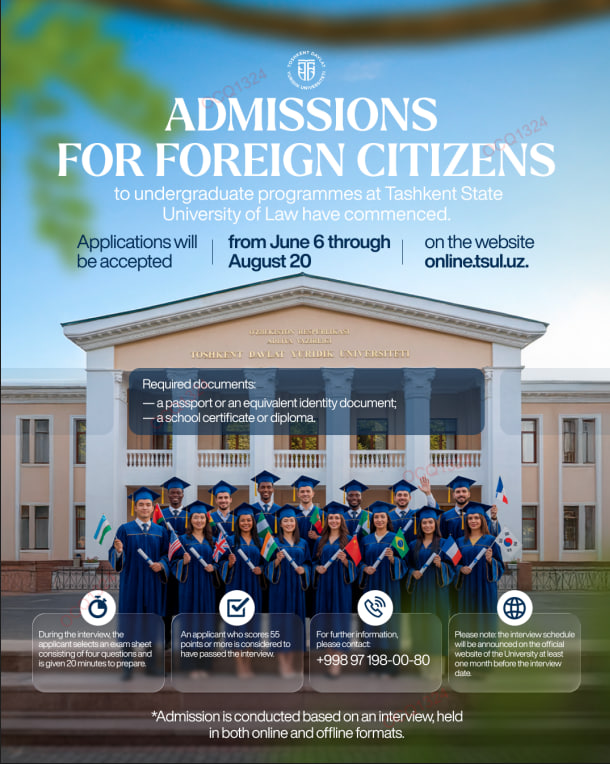
Admission Opportunity for International Applicants at TSUL
📅 17.07.2026
Tashkent State University of Law (TSUL) has introduced a special admission procedure for international applicants seeking enrolment in bachelor’s and master’s degree programmes.
Under this procedure, foreign citizens are admitted without entrance examinations, based on an interview.
Applications may be submitted through the University’s online platform at https://online.tsul.uz until 20 August 2026.
This opportunity has been established pursuant to Presidential Decree No. PF–5987 of 29 April 2020, “On Additional Measures to Radically Improve Legal Education and Science in the Republic of Uzbekistan.”
EDUCATIONAL INTEGRATION IN CENTRAL ASIA: NEW OPPORTUNITIES WITHIN THE SCO
📅 12.08.2026
Owing to its geographical location, Central Asia has long served as a global crossroads where different civilisations, cultures, scientific schools and centres of learning converged. Today, the integration of education and science, academic mobility and joint research pursued within the Shanghai Cooperation Organisation are not merely a modern necessity; they are a natural and consistent process rooted in the region’s millennia-old historical and cultural heritage and rich scholarly traditions.
Certainly, the integration of knowledge and learning in Central Asia has never been constrained by borders or national and ethnic divisions. Along the Great Silk Road, not only a wide variety of goods but also progressive ideas, scientific discoveries and teaching methods were exchanged intensively. Clear evidence of this can be seen in the teachings of the Avesta — “good thoughts, good words, good deeds” — and in the Sogdian and Bactrian cultures, which embodied the earliest foundations of educational and intellectual integration in this land.
The historical reality that unfolded in the region — the Eastern Renaissance — turned Central Asia, on the basis of linguistic, spiritual and political commonality, into a centre of global science and education.
In particular, during the period of Tsarist conquest and the complex geopolitical circumstances that followed, Central Asia’s enlightened reformers — the Jadids — called for the modernisation of education and the restoration of regional unity. Their enduring legacy and ideas still live in the hearts of the region’s peoples.
These vivid and enduring memories demonstrate that educational integration in Central Asia has deep genetic and cultural roots. It should be noted that the processes now taking place within the SCO and reflected in the higher education system are a logical and modern continuation of these historical traditions.
As the Head of our State noted at the meeting of the leaders of the Central Asian states and Azerbaijan, Central Asia, once fragmented, is now uniting around shared development goals. Today’s complex and unpredictable international environment calls for renewed determination, strong political will and even closer coordination.
Against this backdrop, Azerbaijan’s accession to the format of Consultative Meetings is elevating our cooperation to a qualitatively new, macro-regional level and creating a historic opportunity to form a single space of development and prosperity linking Central Asia, the South Caucasus and Afghanistan.
Modern academic openness and educational reforms in the region are once again helping Central Asia emerge as one of the world’s centres of science and intellectual development. Rapid shifts in geopolitical and socio-economic processes are fundamentally reshaping the role of science, education and intellectual resources on the global stage. Today, as an important platform for political and economic dialogue, the SCO has become a central arena for scientific and technological cooperation capable of ensuring the sustainable development, technological independence and innovation-led growth of our countries.
From this perspective, education and innovation within the SCO are emerging as major driving forces for human capital development and the promotion of peace and stability. Multilateral cooperation in higher education and science is increasingly recognised as a new stage in strengthening interregional ties.
“Our collective strength lies in unity, mutual trust and our unwavering commitment to building together.” Guided by this regional principle, the following strategic objectives need to be pursued:
- transform Central Asia into a globally competitive hub for innovation in education, science, digital technologies, and big data;
- create an environment of sustainable development, strong interconnectedness and good-neighbourliness at the heart of Eurasia;
- strengthen the region’s standing as an international actor and deepen practical cooperation within intergovernmental organisations and “Central Asia Plus” formats.
In particular, creating a shared scientific and educational space within the SCO is opening unprecedented opportunities for the region’s young people. Greater academic mobility, mutual recognition of qualifications and academic credentials, and expanded joint research projects are key pillars for strengthening the overall stability and intellectual capacity of SCO Member states.
It must be acknowledged that cooperation in education and science forms a solid foundation for humanitarian cooperation. A qualitative transformation of work in the humanitarian sphere will further strengthen unity, solidarity and mutual understanding among our peoples and serve as a reliable bridge for passing the noblest values of the “Shanghai Spirit” on to future generations in their fullest form.
The expansion of the SCO University network plays an important role in introducing international standards across the region’s higher education system. This process promotes not only student exchanges but also the formation of a new generation of scholars and professionals capable of jointly addressing complex challenges at the regional level.
Indeed, educational integration fully aligns with the shared long-term interests of the peoples of Central Asia. Through the SCO platform, higher education institutions can jointly harness digital learning and artificial intelligence and exchange expertise and resources in science and technology — an essential condition for economic growth.
Support for educational initiatives in the region is one of the most effective ways to strengthen geopolitical stability and cultural dialogue. Moreover, environmental protection, the introduction of green technologies and environmental security have always been, and will remain, priorities on the regional agenda. Knowledge exchange among young people and researchers will advance science and elevate the longstanding bonds of friendship and mutual trust among our peoples to a new level.
Encouragingly, new educational initiatives within the SCO are helping Central Asian universities secure a worthy place in the global academic community. Joint programmes and grants being developed provide talented young people in the region with opportunities to receive high-quality education both at home and in partner countries.
In recent years, at the initiative of the Head of our State, the development of science, technology and innovation has been designated one of the highest priorities of state policy. Systemic reforms are being consistently implemented to build a modern innovation-driven economy based on knowledge, scientific research and technological entrepreneurship. The practical results of these reforms and the major milestones achieved are reflected in substantial figures and concrete indicators.
In 2025 alone, Uzbekistan carried out extensive work to develop human capital and broadly engage young people in science. More than 250 young scientists completed internships and practical training at leading research centres abroad, while 5,250 PhD and DSc admission quotas were allocated for postgraduate education.
At the same time, more than 50,000 young innovators participated in youth technopark programmes.
As a mark of international recognition of these systemic reforms, Uzbekistan strengthened its position in the Global Innovation Index, ranking 79th among 139 countries.
Importantly, the era of declarative statements in education and science is over; today, the SCO is becoming a platform for concrete projects and strategic initiatives.
In particular, at the 10th Meeting of the Ministers of Education of the SCO Member States, held in Belarus on 16 June 2026, the idea of strengthening mutual trust through education and expanding the space for cooperation and knowledge became the central theme. The initiatives put forward at the forum by K. Sharipov, Minister of Higher Education, Science and Innovation of the Republic of Uzbekistan, as well as Uzbekistan’s experience in expanding access to education, attracted the close attention of the Member States.
At the same time, the expansion of innovation cooperation was discussed in detail at the 10th Meeting of the Heads of Ministries of Science and Technology of the SCO Member States, held in Bishkek on 22 May 2026.
In 2025, the Ministry of Higher Education, Science and Innovation of the Republic of Uzbekistan and the relevant institutions of SCO Member States announced an international call for joint scientific projects. The call, which envisaged applied and innovation-oriented research with partners from Russia, Belarus, Kazakhstan, China and Pakistan, attracted strong interest from the scientific community and received numerous applications.
Another important instrument for strengthening human capital across the SCO
is academic mobility.
In recent years alone, the Agency for Innovative Development has organized research internships for more than 140 young researchers and specialists at leading scientific and educational centres in China, Russia, Kazakhstan and India.
This is becoming a robust mechanism for long-term cooperation and the training of a new generation of scientists.
Ahead of the 25th anniversary of the Shanghai Cooperation Organisation and the Bishkek Summit, the expert community, while reviewing the Organisation’s achievements, recognises humanitarian and educational cooperation as one of the most vital areas of its work.
As noted, the SCO’s greatest achievement over the past quarter-century is that it has sustained dialogue among states with different political and cultural perspectives.
Today, the concept of security is no longer limited to military or border-related factors; it also encompasses digital development, artificial intelligence,
the environment and human capital development.
For an organization that brings together nearly 40 percent of the world’s population and vast intellectual resources, educational integration is the only sound path to maintaining stability amid geopolitical competition.
In this context, special mention should be made of the international competition
“100 Future Innovators of the SCO,” held among young people from SCO Member States as part of the successfully organised “Engineers of the Future” International Festival in Tashkent.
Such events bring together students, young scientists, engineering teams and technology teams, thereby strengthening youth diplomacy and technological leadership across the SCO.
In accordance with the final documents and declarations of the SCO Council of Heads of State and meetings of sectoral ministers, the integration of education and science in Central Asia and the broader SCO region is recognised not as routine inter-institutional cooperation but as the most prudent strategic investment in the region’s sustainable development, peace, good-neighbourliness and competitiveness.
In conclusion, the digital ecosystems being built together, green science initiatives and sincere academic dialogue among young people will play a decisive role in turning the SCO region into a powerful engine of global development and innovation.
Ministry of Higher Education, Science and Innovation
of the Republic of Uzbekistan,
Head of the Department,
Fazliddin Muminov
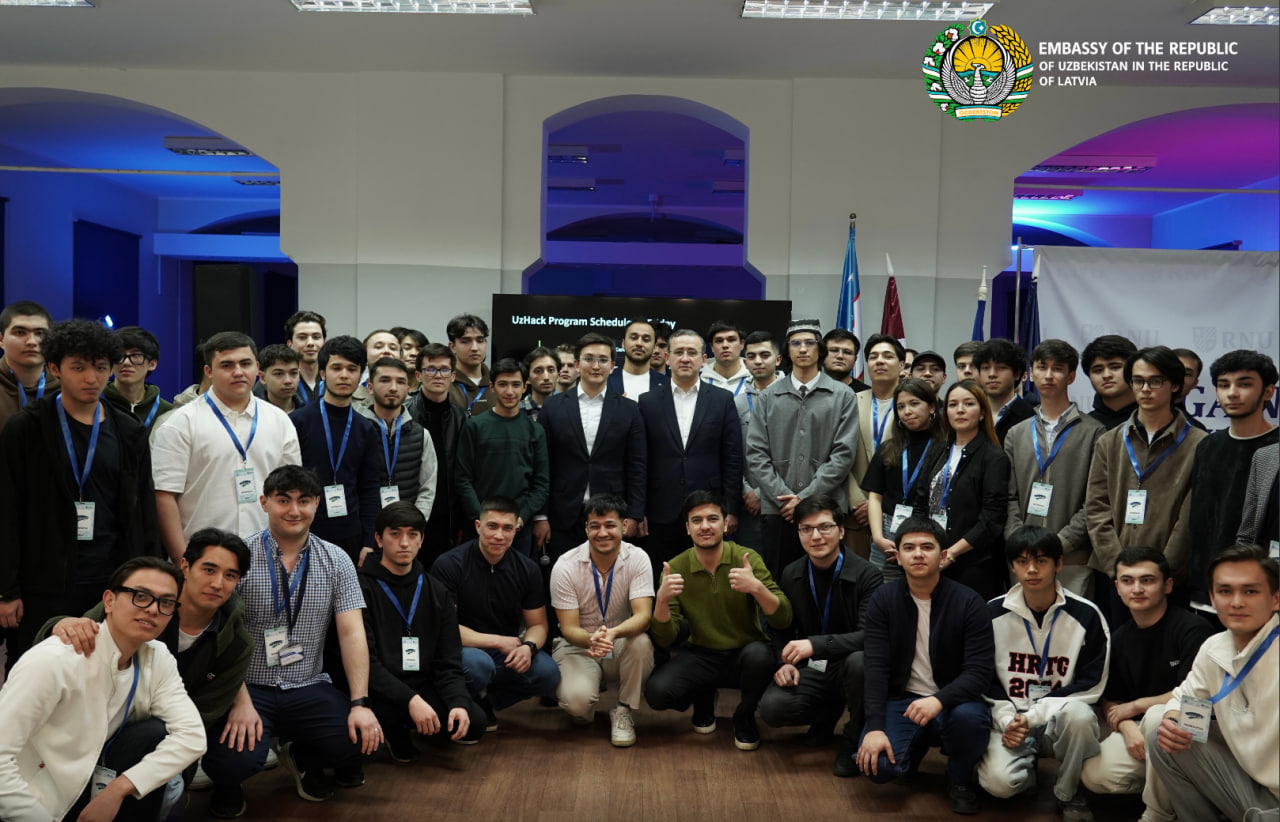
UzHack international hackathon organized in Riga with participation of Uzbek students
📅 01.04.2026
The Embassy of the Republic of Uzbekistan in Latvia initiated and organized, for the first time, the international hackathon “UzHack” in Riga with the participation of Uzbek students studying in the Baltic States - Latvia, Lithuania, and Estonia.
The project was implemented in cooperation with the “Vatandoshlar” Public Foundation and the World Association of Youth of Uzbekistan.
During the hackathon, participants worked intensively for 48 hours on practical case studies provided by leading government and technology organizations, developing innovative solutions.
More than 70 young participants took part in the event, forming a total of 13 teams. Following the selection rounds, the top 4 teams advanced to the final stage, where they successfully presented and defended their projects before an expert jury.
The “UzHack” hackathon served as an important platform for Uzbek youth abroad to exchange knowledge and experience, strengthen teamwork skills, and foster innovative thinking.
Such initiatives play a significant role in unlocking the intellectual potential of Uzbek youth abroad, uniting them around a common purpose, and creating a strong foundation for future innovative development.

-
 Ministry of Foreign Affairs of the Republic of Uzbekistan
 -
 Diplomatic Service of the Ministry of Foreign Affairs
 -
 State Committee for Tourism Development
 -
Ministry of Investments and Foreign Trade of the Republic of Uzbekistan
-
 invest.gov.uz
 -
-

-

-
-
-

-

of Uzbekistan in the Republic
of Latvia
When using the information, a link to www.uzembassy.lv
must be provided.
All rights reserved
Address
Address: Riga c., LV-1010. 11-11 Elizabetes Str., Latvia
Phone: 37167322424
Fax: 37167322306
Email: embassy@uzbekistan.lv
Useful links
HomeIssuance of biometric passport for departure abroad
Certificate to return to Uzbekistan
Withdrawal of citizenship
Loss of citizenship