Phone
Consular Issues
Phone
Embassy messages
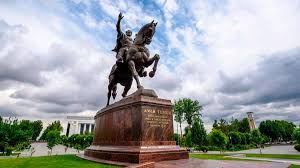
A masterpiece of our distinguished history
During one of his visits to the Kashkadarya province, President of Uzbekistan, Shavkat Mirziyoyev, emphasized the profound wisdom and exemplary value embedded in the literary works dedicated to our historical figures. In particular, he highlighted the significance of texts related to Amir Temur, most notably the Temur tuzuklari (Institutes of Temour), which he identified as a critical source for understanding our national heritage. The President stressed again the necessity of comprehensive scholarly engagement with this text, recognizing it as a testament to the intellectual and statecraft traditions of the Uzbek people.
The Temur tuzuklari commissioned by Amir Temur, occupies a prominent place in the historiography of world civilization. Its significance is multifaceted. First, the authorship is attributed to a statesman of exceptional strategic and intellectual capacity, and the text has remained a subject of sustained scholarly interest. Second, the clarity of the work’s prose enhances both its accessibility and its continued relevance. Third, the work was produced in a period marked by geopolitical realignments and intellectual developments that would later contribute to the European Renaissance. Finally, Amir Temur’s enduring stature within a multipolar global order, all of these factors emphasize the broader historical value of the text, which continues to engage both academic and general audiences.
Temur tuzuklari is a very simple yet deeply meaningful and richly substantive work. To write such a piece, the author must possess a broad worldview, have personally experienced the heavy footsteps of history and the hardships of building an immense state, and must have attained the status of a noble figure who could easily fathom the world, deeply understand history and geography, be well-versed in ethnonymy, toponymy, and be capable of drawing profound conclusions about life, the flow of the world, and the paths of existence, a figure at the level of a wise philosopher. In other words, the Turon saltanati (Turanian kingdom) was the creation of Amir Temur. He referred to himself as the “Sultan of Turan”. In 1391, these words were inscribed in Old Uzbek on stone in Dasht-i Kipchak Steppe. That empire was built through the arduous labor of our forefather, and its institutions did not emerge spontaneously, but arose from pressing necessity (emphasis by the author). Temur tuzuklari came about as a vivid expression of all of this.
Only an individual of Amir Temur’s stature, who, as the historian Nizomiddin Shomiy described, attained perfection and high rank through his own mature effort and determined striving,” and who had acquired firsthand experience in the art of empire-building, could have created the Tuzuklar. The authorship of such a piece lies solely within the capacity of such a figure; there can be no room for doubt in this regard. In fact, a close reading of the Temur tuzuklari reveals the expansive intellectual breadth of its author.
Another important point: it would be illogical, a fundamental error, to suggest that this intellectually rich and thematically mature work, which has been the subject of scholarly inquiry for six centuries and continues to attract global interest, was authored by an anonymous writer and merely “presented” to Amir Temur, with authorship later attributed to him as a gesture of “flattery”. Such speculation lacks credibility. Moreover, Major William Davy, Persian secretary to the Commander in Chief of the Bengal Forces, was the first translator of the Tuzuklar into English, emphasizing that Amir Temur was the genuine author of the work.
The composition of the Tuzuklar appears to have been an iterative process, spanning several years and undergoing multiple revisions, abridgments and expansions.
The Arab historian Mazhar Shihab, as cited by Ubaydulla Uvatov, affirms that “Amir Temur began recording his memoirs long before he assumed power”. This observation suggests that Temur maintained a long-standing interest in documenting his thoughts and experiences and that he may have been reluctant to delegate such a task to others, either out of concern for accuracy or due to the absence of individuals he deemed suitably qualified.
The Temur tuzuklari, enriched with wisdom, also offers invaluable insight into Amir Temur’s character. The text depicts him as a champion of justice, committed to truth, loyalty, and the well-being of his people. He is portrayed as magnanimous, fearless, and principled ruler. He bravely strives to uphold the rights of the oppressed against the tyrants, for he knows that a country may endure with disbelief but cannot tolerate oppression.
Alisher Navoi, a contemporary of Amir Temur’s legacy, begins the seventh chapter (majlis) of his work “Majalis un-Nafais” (The Assemblies of the Refined) with the name of Amir Temur Kuragon. Navoi portrays the Sahibkiran as an intellectual and a man of high spirituality, awarding him the most prestigious place among the “refined souls”.
Navoiy also recounts a remarkable episode that illustrates the Sohibqiron’s powerful memory. When a long-sought criminal–Xoja Abdulkadir Marogi, famous composer, musician, the Qur’an reciter–was finally brought before Amir Temur, the man began reciting the Qur’an in a melodious voice. Moved by the recitation, Temur’s wrath softened and he forgave the offender. Deeply affected, the Sohibqiron then recited a line of poetry in response.
Navoiy was astonished by this poetic line. The Sohibqiron had recited the fourth line of a rubai (quatrain) composed by the renowned Sufi poet and sheikh Abusaid Abulxayr, who had lived about four centuries earlier. Amir Temur had become enamored with this verse and had committed it to memory. This incident reveals not only his deep appreciation for poetry but also his exceptional memory and reverence for spiritual literature. These are precisely such moments that justify the inclusion of Temur’s name in “Majalis un-Nafais”.
Amir Temur was deeply invested in ensuring the accuracy and truthfulness of the work being produced. In this context, the guidance, instructions, demands, advice, and reflections he directed toward the authors, reflecting his intellectual acuity and refined cultural sensibilities, are particularly compelling and merit close scholarly attention.
One thing appears particularly striking: for nearly two centuries after Amir Temur’s death, no information can be found regarding Tuzuklar or its fate. The work seemed to have been engulfed in a darkness of neglect and oblivion.
“The 'Tuzuk-i-Timuri” (Temur Tuzuklari) was a high document of the empire and a state secret; such a document exists in only one, at most two copies, kept in strict confidentiality and secrecy.
Major Davy once wrote the following about Boburnoma: “The book of Baburnama, too, remained in the shadows of neglect and forgetfulness until nearly the middle of the reign of Bobur’s grandson, Emperor Akbar (1566–1605), when it was finally translated from Chagatai Turkic into Persian. Until that time, no one in either Asia or Europe had questioned the authenticity of Babur’s memoirs. Nevertheless, this work, like Tuzuklar, eventually faced a similar degree of scholarly neglect.
An essential scholarly and cultural imperative now rests with leading institutions, including the International Amir Temur Public Foundation, the State Museum of the History of the Temurids, the Al-Beruniy Institute of Oriental Studies of the Academy of Sciences of Uzbekistan, Institute of History of the Academy of Sciences and the Center for Islamic Civilization in Uzbekistan, as well as with the broader intellectual community: namely, to locate the original manuscript of the “The 'Tuzuk-i-Timuri” - Temur tuzuklari, subject it to rigorous academic scrutiny, and reintegrate this foundational text into the corpus of the nation’s cultural and historical legacy.
The recovery of the authentic manuscript, an unparalleled artifact that reflects the political thought and historical consciousness of a pivotal epoch, would constitute a landmark achievement in the advancement of Uzbek historiography and civilizational self-understanding.
Muhammad ALI
Chairman, International Amir Temur Public Foundation
Distinguished Writer of Uzbekistan, Professor
📅 18.03.2026
Embassy messages
The Ministry of Foreign Affairs of the Republic of Uzbekistan has launched the “Consular Services” mobile application
Consular Services Reception Procedure at the Embassy of Uzbekistan in Latvia
Узбекистан и страны Балтии объединяют усилия в борьбе с коррупцией
Uzbek specialists study Latvia’s best practices in veterinary and livestock sectors
Uzbekistan and Finland discussed prospects for cooperation in the field of entrepreneurship support
A holiday of unity: Navruz celebration connects nations in Riga
Trade union delegation of Uzbekistan discusses in Latvia issues of protecting the rights of compatriots – labor migrants
Ambassador of Uzbekistan presented his credentials to the President of Lithuania
Uzbekistan and Finland are preparing for the next meeting of the intergovernmental commission and a business forum within its framework
Discussions on potential areas of cooperation with the Association of European Chambers of Commerce and Industry were held in Riga
Uzbekistan and Latvia agreed to prepare a bilateral agreement on cooperation in the field of labor migration
Uzbekistan and Latvia ready for permanent dialogue in the field of labor migration
Торговый дом Узбекистана в Латвии провел онлайн-тренинг для хокимов и экспортеров Сырдарьинской области
Uzbek delegation studied Finland's experience in preventing violence against children
A festive evening for compatriots was organized in Estonia
Latvia widely celebrated the anniversary of the adoption of the Basic Law of Uzbekistan
Возможности медицинского туризма в Узбекистане презентованы в Риге
New contracts worth over $4 million signed as part of Uzbek exporters' business mission to Latvia
A roundtable discussion on the topic "Mirzo Ulugbek: a great encyclopedist and a famous statesman" was held in Riga
СМИ Латвии: Явка на выборах в Узбекистане составила 74,72%
Досрочное голосование по выборам в Законодательную палату Олий Мажлиса Узбекистана проходит в Латвии
В Латвии и Литве обсуждаются ключевые аспекты предстоящих парламентских выборов в Узбекистане
Issues related to the development of cooperation between Uzbekistan and Latvia in the field of combating crime discussed in Riga
A round table was held in Latvia on the upcoming elections in Uzbekistan to the Legislative Chamber of the Oliy Majlis and Kengashes of People's Deputies
Uzbek exporters familiarized with requirements for import of Uzbek products to Latvian and European markets
Export of agricultural products from Uzbekistan to the Latvian market increases
ЭЪЛОН!
Uzbek ambassador meets Latvian Saeima speaker to discuss prospects for boosting inter-parliamentary cooperation
Diplomats of Uzbekistan held a visiting reception of fellow citizens living in Estonia and Finland
Ambassador of Uzbekistan presents credentials to President of Latvia

-
 Ministry of Foreign Affairs of the Republic of Uzbekistan
 -
 Diplomatic Service of the Ministry of Foreign Affairs
 -
 State Committee for Tourism Development
 -
Ministry of Investments and Foreign Trade of the Republic of Uzbekistan
-
 invest.gov.uz
 -

-

-

-

-

-

-


of Uzbekistan in the Republic
of Latvia
When using the information, a link to www.uzembassy.lv
must be provided.
All rights reserved
Address
Address: Riga c., LV-1010. 11-11 Elizabetes Str., Latvia
Phone: 37167322424
Fax: 37167322306
Email: embassy@uzbekistan.lv
Useful links
HomeIssuance of biometric passport for departure abroad
Certificate to return to Uzbekistan
Withdrawal of citizenship
Loss of citizenship