Phone
Consular Issues
Phone
Embassy messages
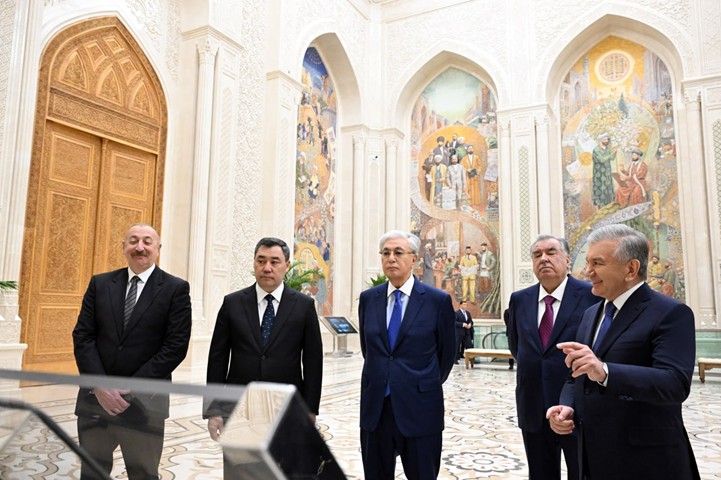
Third Renaissance: Center of Islamic Civilization as a strategy for Spiritual and Intellectual Advancement of New Uzbekistan
Human history demonstrates that every great advancement is built upon intellectual and spiritual foundations. Today, a project emerging from the heart of Central Asia is drawing global attention for its scale and significance - Center of Islamic Civilization is not merely an architectural landmark, but an intellectual bridge connecting the past, present and future of the region.
The anticipated opening of the complex in March 2026 has already attracted the attention of leading international publications and organizations, recognizing it as one of the most significant cultural projects of the New Uzbekistan.
The foundation for the project was laid in 2017, when President Shavkat Mirziyoyev introduced the initiative at the 72nd session of the United Nations General Assembly. At that time, Leader of Uzbekistan emphasized the need to show the international community the true humanistic essence of Islam - enlightenment, peace and creation. This was not only a political statement but also a program for returning to the roots of a land that for centuries served as a cradle of science and culture.
The emergence of this monumental project coincides with a global need for spiritual transformation. In an era where Islamophobia and radicalism are spreading across different parts of the world, Uzbekistan has proposed a model to confront these challenges through science and education.
Today, this vision has materialized in a majestic complex covering ten hectares in the historic center of Tashkent. Its 65-meter azure dome and four golden gates symbolically represent the unity of all regions of Uzbekistan. Across every line of the building, architectural traditions of the Timurid era are harmoniously integrated with modern technological solutions.
Center embodies a balance of religion and science. Its main pillar, reflecting the rich architectural traditions of Ulugh Beg Madrasah, is adorned with a calligraphic inscription of the first revealed verse of the Qur’an, “Iqra” (“Read in the name of your Lord”), symbolizing the pursuit of knowledge as the highest spiritual duty of every individual.
The centerpiece of the exhibition is the 7th-century Uthman Qur’an, a unique sacred relic inscribed by UNESCO in the “Memory of the World” Register.
The architectural concept of the complex impresses not only with its grandeur but also with its full compliance with contemporary urban planning and environmental sustainability standards. Every element of the project - from the foundation to the dome - has been constructed with respect for historical heritage and designed for longevity. The landscaped grounds surrounding the complex transform it into more than a scientific center, creating a spacious cultural and educational zone accessible to both city residents and international visitors.
The exhibition concept of the Center fundamentally departs from that of traditional museums. Built upon the principle endorsed by Shavkat Mirziyoyev, “Civilization – Personalities – Discoveries”, it does more than present historical facts; it immerses visitors in a living intellectual innovation. The exhibition is organized chronologically: the pre-Islamic period, the First and Second Renaissance and New Uzbekistan - forming the foundation of the Third Renaissance.
A special feature is the “Wall of Civilizations”, which showcases humanity’s intellectual progress as a continuous process. It illustrates how the discoveries of great figures from each era - including Al-Khwarizmi, Al-Farghani, Ibn Sina, Al-Biruni, and Mirzo Ulughbek - are directly linked to modern high technologies.
The extensive use of VR and AR technologies, holograms, and artificial intelligence enables the Center to “bring to life” unique 9th-century manuscripts, digitally reconstruct the original appearance of ancient observatories and transport past discoveries into the digital realm.
This large-scale integration of digital technologies positions the Center as a museum of the future. Through smart systems, visitors not only receive visual information but can virtually interact with great scientists and participate in their laboratory experiments. The “1001 Inventions” Laboratory, designed for children, sparks early interest in engineering and natural sciences. Center thus evolves beyond a repository of knowledge, becoming an interactive educational platform that nurtures the nation’s intellectual potential.
Shavkat Mirziyoyev, President of Uzbekistan, has repeatedly emphasized that the true strength of a nation lies in its memory and cultural roots. He instructed that museum exhibitions be enriched with authentic examples of national heritage and that the rarest artifacts preserving the spirit and history of the Uzbek people be returned to the homeland.
In fulfillment of this noble vision, a delegation led by Firdavs Abdukhalikov, Director of the Center of Islamic Civilization and a special commission of scholars, Orientalists and art historians, conducted large-scale research. One of the Center’s most important tasks is the repatriation of national cultural heritage scattered abroad; in recent years, systematic cooperation has been established with prestigious auction houses and private collectors for this purpose.
Thanks to these efforts, more than a thousand unique manuscripts and artifacts have been returned to Uzbekistan. The World Society for the Study, Preservation and Promotion of the Cultural Heritage of Uzbekistan (WOSCU) has also transferred numerous unique artworks from Transoxiana and Khorasan to the Center's collection.
Scientific expeditions and diplomatic missions organized by the Government of Uzbekistan have facilitated the creation of facsimile copies of manuscripts preserved in major museums and libraries worldwide. This process underscores that the rich cultural heritage of the Uzbek people is not only the legacy of Central Asia but also an integral part of the Islamic world and human civilization. Each repatriated treasure symbolizes the determination of the New Uzbekistan to restore its cultural identity.
The Center of Islamic Civilization is conceived not merely as a museum, but as an active scientific and educational platform. It provides comprehensive facilities for researchers, including a library housing over 200,000 volumes, restoration laboratories, a calligraphy school, and digital archives. Center also hosts offices of prestigious international organizations - including ICESCO, IRCICA and OCIS (Oxford Centre for Islamic Studies) - highlighting its role as a major hub for scientific and educational engagement.
More than 1,500 specialists from over 40 countries contributed to the project. International experts, including Khaled El-Enany, have described the Center as a “unique civilizational complex, integrating a next-generation museum, advanced research infrastructure, a modern library, national and international archives on the history of Central Asian civilizations, digital humanities technologies and an extensive network for global scientific and cultural collaboration”.
President of Finland, Alexander Stubb, referred to the Center as an intellectual hub of the modern world, likening it to historical institutions such as the Bayt al-Hikma, Academy of Ma’mun and Ulugh Beg Madrasah, which once shaped the development of science.
At the Congress “Central Asia: Shared Spiritual and Educational Heritage – Shared Future”, Center was visited by five presidents, becoming a symbol of collective regional pride. The event also brought together more than 300 scholars and cultural figures from Central Asian countries and Azerbaijan.
In February 2026, new reports from Paris further bolstered the project’s global prestige. The International Committee of the “Prix Versailles” included Center of Islamic Civilization in Tashkent in the list of the “World's most beautiful museums of 2026”.
This recognition is further reinforced by the inclusion of the Center of Islamic Civilization in authoritative international publications and rankings, such as “Smithsonian Magazine”, “BBC Travel”, “BBC History” and “National Geographic”. This places it alongside the world’s major museum initiatives, including the “Lucas Museum of Narrative Art” (Los Angeles), “National Geographic Museum of Exploration” (Washington, D.C.) and “London Museum” (London).
Such acclaim significantly enhances the Center’s scientific and tourism potential, transforming it into a must-visit global landmark. These achievements vividly demonstrate the creative potential of New Uzbekistan and its innovative approach that meets international standards.
It is no coincidence that the Center’s opening coincides with the Holy month of Ramadan. It was in 2018, during this blessed month, that the first stone of this grand project was laid. Now, eight years later, Center of Islamic Civilization will open its doors, becoming a vital symbol of the revival and preservation of Islamic cultural heritage for future generations.
📅 12.03.2026
Embassy messages
The Ministry of Foreign Affairs of the Republic of Uzbekistan has launched the “Consular Services” mobile application
Consular Services Reception Procedure at the Embassy of Uzbekistan in Latvia
Узбекистан и страны Балтии объединяют усилия в борьбе с коррупцией
Uzbek specialists study Latvia’s best practices in veterinary and livestock sectors
Uzbekistan and Finland discussed prospects for cooperation in the field of entrepreneurship support
A holiday of unity: Navruz celebration connects nations in Riga
Trade union delegation of Uzbekistan discusses in Latvia issues of protecting the rights of compatriots – labor migrants
Ambassador of Uzbekistan presented his credentials to the President of Lithuania
Uzbekistan and Finland are preparing for the next meeting of the intergovernmental commission and a business forum within its framework
Discussions on potential areas of cooperation with the Association of European Chambers of Commerce and Industry were held in Riga
Uzbekistan and Latvia agreed to prepare a bilateral agreement on cooperation in the field of labor migration
Uzbekistan and Latvia ready for permanent dialogue in the field of labor migration
Торговый дом Узбекистана в Латвии провел онлайн-тренинг для хокимов и экспортеров Сырдарьинской области
Uzbek delegation studied Finland's experience in preventing violence against children
A festive evening for compatriots was organized in Estonia
Latvia widely celebrated the anniversary of the adoption of the Basic Law of Uzbekistan
Возможности медицинского туризма в Узбекистане презентованы в Риге
New contracts worth over $4 million signed as part of Uzbek exporters' business mission to Latvia
A roundtable discussion on the topic "Mirzo Ulugbek: a great encyclopedist and a famous statesman" was held in Riga
СМИ Латвии: Явка на выборах в Узбекистане составила 74,72%
Досрочное голосование по выборам в Законодательную палату Олий Мажлиса Узбекистана проходит в Латвии
В Латвии и Литве обсуждаются ключевые аспекты предстоящих парламентских выборов в Узбекистане
Issues related to the development of cooperation between Uzbekistan and Latvia in the field of combating crime discussed in Riga
A round table was held in Latvia on the upcoming elections in Uzbekistan to the Legislative Chamber of the Oliy Majlis and Kengashes of People's Deputies
Uzbek exporters familiarized with requirements for import of Uzbek products to Latvian and European markets
Export of agricultural products from Uzbekistan to the Latvian market increases
ЭЪЛОН!
Uzbek ambassador meets Latvian Saeima speaker to discuss prospects for boosting inter-parliamentary cooperation
Diplomats of Uzbekistan held a visiting reception of fellow citizens living in Estonia and Finland
Ambassador of Uzbekistan presents credentials to President of Latvia

-
 Ministry of Foreign Affairs of the Republic of Uzbekistan
 -
 Diplomatic Service of the Ministry of Foreign Affairs
 -
 State Committee for Tourism Development
 -
Ministry of Investments and Foreign Trade of the Republic of Uzbekistan
-
 invest.gov.uz
 -

-

-

-

-

-

-


of Uzbekistan in the Republic
of Latvia
When using the information, a link to www.uzembassy.lv
must be provided.
All rights reserved
Address
Address: Riga c., LV-1010. 11-11 Elizabetes Str., Latvia
Phone: 37167322424
Fax: 37167322306
Email: embassy@uzbekistan.lv
Useful links
HomeIssuance of biometric passport for departure abroad
Certificate to return to Uzbekistan
Withdrawal of citizenship
Loss of citizenship