Phone
Consular Issues
Phone
Embassy messages
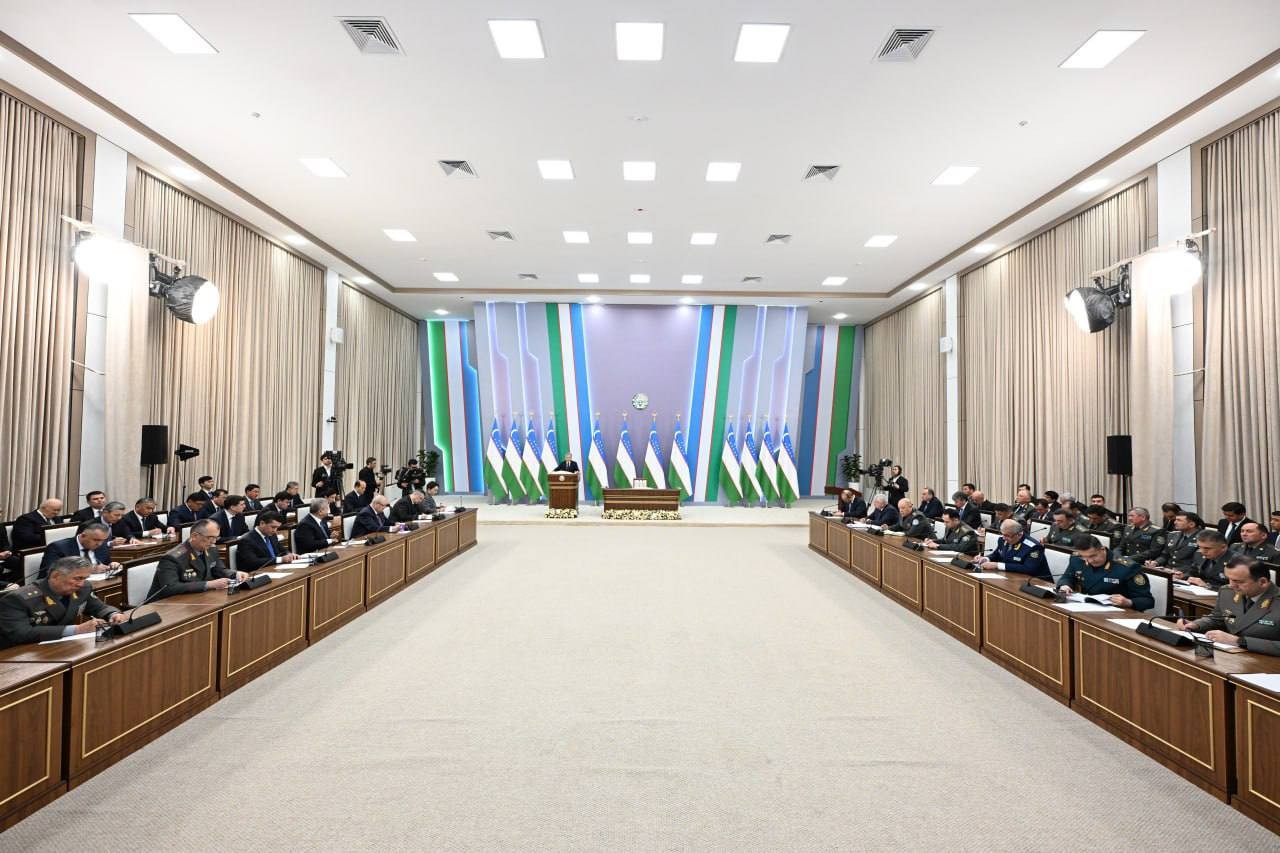
In the vision of the President of Uzbekistan, security is not an isolated military task, but a multidimensional foundation for the sustainable development of the state in the digital age
To mark Defenders of the Homeland Day and the 34th anniversary of the Armed Forces of the Republic of Uzbekistan, a number of significant state events were held. Key events included an expanded meeting of the Security Council chaired by President Shavkat Mirziyoyev, a tour of the defense industry's production facilities, and the head of state's address to military personnel and compatriots.
In this regard, a correspondent of Dunyo IA approached Akramjon Nematov, First Deputy Director of the Institute for Strategic and Regional Studies under the President of Uzbekistan, with a request to comment on the key outcomes of these events and the tasks outlined by the country’s leader:
- It's no exaggeration to say that today, the Supreme Commander-in-Chief of Uzbekistan laid the foundation for a new stage in the modernization of the national army—its high-tech transformation. I would even say that Shavkat Miromonovich's congratulations this year were not simply a tribute to tradition, but a kind of manifesto for the "New Look Army," where intelligence and technology must finally supplant outdated approaches to warfare. In the President's vision, security is not an isolated military task, but a multidimensional foundation for the sustainable development of the state in the digital age.
By analyzing the key messages of the head of state, one can trace a clear and consistent logic for the transformation of all elements of the public administration system.
The key innovation of the current stage of reforms lies in the recognition of the profound transformation of the very nature of modern warfare, in which technological superiority, rather than personnel numbers, is decisive. This is why the President of Uzbekistan has set the task of a large-scale doctrinal update: the development of a new version of the Defense Doctrine and the National Security Concept has been initiated. This is dictated by the need to adapt strategic documents to the conditions of hybrid threats while simultaneously maintaining Uzbekistan's non-aligned status and reliance on multilateral diplomacy. This sends a clear signal to the country about the predictability and sovereignty of the republic's course.
The central element of the updated strategy is the transition to a “proactive mode of operation,” in which the security system must not only respond to emerging threats, but also be capable of predicting risks in advance and neutralizing them at an early stage.
This intellectualization of security naturally requires a review of the Armed Forces' technical makeup. In this regard, the head of state initiated a thorough re-equipment of the army, prioritizing the implementation of artificial intelligence, robotic systems, and modern cybersecurity systems. It was emphasized that in modern conflicts, victory is achieved not by the number of bayonets, but by technological superiority and the speed of information processing. In this context, the digital transformation of the army becomes an undisputed priority. In other words, in modern warfare, intelligence is more important than mass, and victory is determined by the quality of technology and management.
At the same time, high technology demands a fundamentally new level of competence. Therefore, a true personnel transformation has been initiated: the army is being positioned not as a closed institution, but as a modern educational and technological platform. It is becoming a school of life and professional growth, as well as a driver of economic development. Every year, 5,000 conscripts will undergo training under the "One Million Programmers" and "Five Million AI Leaders" programs. This strategic move allows us to simultaneously address two objectives: increasing the army's cyber resilience and creating a pool of in-demand specialists for the country's economy.
Furthermore, the program provides for training soldiers in civilian professions, with the issuance of state-issued certificates upon completion of their service. For military personnel opening a business after demobilization, the state will reimburse 6% of the loan interest rate. Educational incentives are also being introduced: the opportunity to take university entrance exams directly at military units, interest-free student loans for those entering universities after service, and reimbursement of the costs of obtaining international language certificates. This approach reflects the current trend of developing "smart forces," in which the country's defenders are also qualified specialists in demand in the civilian sector.
In this way, the army is organically integrated into the civil society system, providing young people with real tools for personal and professional success.
For this model to function effectively, a solid social foundation is essential. Therefore, an unprecedented strengthening of social protection for military personnel has become a logical continuation of the reforms. The decisions to double officers' length-of-service bonuses and pay veterans pensions equal to 100% of their pay are, in my view, a strategic investment in the prestige of military service. Additionally, a 10% increase in pay for privates and contract sergeants is envisaged, as well as a 20% increase in the salaries of civilian defense personnel this year and a further 50% increase next year.
The President clearly demonstrates that the state takes full responsibility for the well-being of those who defend the Motherland, thereby raising the prestige of military service and strengthening the principle of unity between the people and the army.
The final element of this comprehensive strategy is achieving profound technological self-sufficiency. The modernization of the national defense-industrial complex, the creation of domestic military technology parks, and the development of unmanned systems production are aimed at minimizing external dependence. A visit to the Chirchik Aircraft Plant and defense technology parks clearly demonstrates that Uzbekistan is focusing on localization, a service economy, and the development of its own industrial base. The creation of a regional hub for Airbus equipment maintenance is not only a matter of prestige but also a practical step toward technological independence and integration into global production chains.
All this strengthens state sovereignty, enabling the effective protection of national interests by relying on its own innovative potential and competencies. At the same time, the military is becoming a driver of innovative development: technologies developed for defense purposes inevitably find application in civilian sectors.
In conclusion, it should be emphasized that the announced initiatives mark a definitive departure from outdated models. Essentially, we are witnessing the emergence of a new model of statehood, one in which high-tech sovereignty, intellectual capital, and social justice are integrated into a single strategy.
A highly mobile, technologically advanced army is being created, capable of effectively countering hybrid threats in the changing nature of warfare. The army serves not only as a shield for the state but also as a driver of education, the economy, and social mobility—a modern, pragmatic, and deeply national approach to development and security in the new global reality.
Dunyo IA
📅 22.01.2026
Embassy messages
The Ministry of Foreign Affairs of the Republic of Uzbekistan has launched the “Consular Services” mobile application
Consular Services Reception Procedure at the Embassy of Uzbekistan in Latvia
Узбекистан и страны Балтии объединяют усилия в борьбе с коррупцией
Uzbek specialists study Latvia’s best practices in veterinary and livestock sectors
Uzbekistan and Finland discussed prospects for cooperation in the field of entrepreneurship support
A holiday of unity: Navruz celebration connects nations in Riga
Trade union delegation of Uzbekistan discusses in Latvia issues of protecting the rights of compatriots – labor migrants
Ambassador of Uzbekistan presented his credentials to the President of Lithuania
Uzbekistan and Finland are preparing for the next meeting of the intergovernmental commission and a business forum within its framework
Discussions on potential areas of cooperation with the Association of European Chambers of Commerce and Industry were held in Riga
Uzbekistan and Latvia agreed to prepare a bilateral agreement on cooperation in the field of labor migration
Uzbekistan and Latvia ready for permanent dialogue in the field of labor migration
Торговый дом Узбекистана в Латвии провел онлайн-тренинг для хокимов и экспортеров Сырдарьинской области
Uzbek delegation studied Finland's experience in preventing violence against children
A festive evening for compatriots was organized in Estonia
Latvia widely celebrated the anniversary of the adoption of the Basic Law of Uzbekistan
Возможности медицинского туризма в Узбекистане презентованы в Риге
New contracts worth over $4 million signed as part of Uzbek exporters' business mission to Latvia
A roundtable discussion on the topic "Mirzo Ulugbek: a great encyclopedist and a famous statesman" was held in Riga
СМИ Латвии: Явка на выборах в Узбекистане составила 74,72%
Досрочное голосование по выборам в Законодательную палату Олий Мажлиса Узбекистана проходит в Латвии
В Латвии и Литве обсуждаются ключевые аспекты предстоящих парламентских выборов в Узбекистане
Issues related to the development of cooperation between Uzbekistan and Latvia in the field of combating crime discussed in Riga
A round table was held in Latvia on the upcoming elections in Uzbekistan to the Legislative Chamber of the Oliy Majlis and Kengashes of People's Deputies
Uzbek exporters familiarized with requirements for import of Uzbek products to Latvian and European markets
Export of agricultural products from Uzbekistan to the Latvian market increases
ЭЪЛОН!
Uzbek ambassador meets Latvian Saeima speaker to discuss prospects for boosting inter-parliamentary cooperation
Diplomats of Uzbekistan held a visiting reception of fellow citizens living in Estonia and Finland
Ambassador of Uzbekistan presents credentials to President of Latvia

-
 Ministry of Foreign Affairs of the Republic of Uzbekistan
 -
 Diplomatic Service of the Ministry of Foreign Affairs
 -
 State Committee for Tourism Development
 -
Ministry of Investments and Foreign Trade of the Republic of Uzbekistan
-
 invest.gov.uz
 -
-

-

-

-

-

-


of Uzbekistan in the Republic
of Latvia
When using the information, a link to www.uzembassy.lv
must be provided.
All rights reserved
Address
Address: Riga c., LV-1010. 11-11 Elizabetes Str., Latvia
Phone: 37167322424
Fax: 37167322306
Email: embassy@uzbekistan.lv
Useful links
HomeIssuance of biometric passport for departure abroad
Certificate to return to Uzbekistan
Withdrawal of citizenship
Loss of citizenship