Phone
Consular Issues
Phone
Uzbekistan news
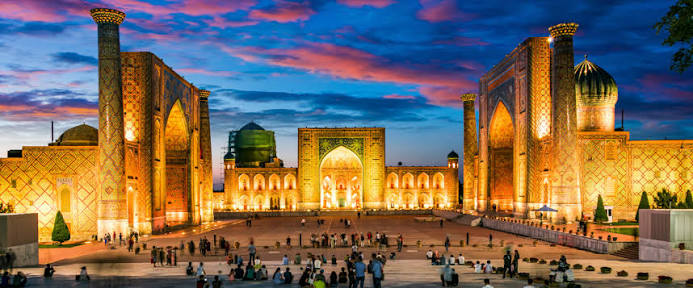
UZBEKISTAN DEVELOPS TOURISM THROUGH NEW ROUTES AND PARTNERSHIPS
Tourism in Uzbekistan is experiencing a period of notable growth. More and more international travelers are choosing the country, and as tourist flows increase, so do opportunities for travel: new routes and tourism products are emerging, while ties with foreign partners are becoming stronger. From January to August 2026, Uzbekistan welcomed 9.1 million foreign tourists — 21.1% more than during the same period last year.
Cooperation with the CIS countries plays an important role in this process. Uzbekistan shares long-standing cultural ties, well-developed transport connections, and sustained mutual interest in travel with these countries. The figures are telling. In the first eight months of 2026, nearly 868,000 tourists from Russia visited Uzbekistan — 30.8% more than a year earlier. As a result, among countries that do not border Uzbekistan, Russia is the largest source of tourists. Growth in tourist flows from Azerbaijan has been even more pronounced: the number of travelers from Azerbaijan to Uzbekistan increased by 63.3% compared with the same period last year, reaching 22,000.
These figures are also the result of practical cooperation — from transport links and direct contacts between tourism industry representatives to the promotion of new destinations and travel programs. In March, for example, Uzbekistan presented its tourism potential at MITT-2026, the Moscow International Exhibition of Tourism and Hospitality Industry, where B2B meetings were held with Russian partners, involving more than 200 companies. Air connectivity is also expanding: the Kazan–Tashkent route was launched in 2026, while further expansion of the direct-flight network is under discussion, including routes from Russia to Samarkand, Bukhara, Namangan, and Fergana.
With Azerbaijan, one of the notable areas of cooperation has been the joint promotion of the two countries' tourism opportunities abroad. In 2025, Uzbekistan and Azerbaijan held the European roadshow “Highlights of the Silk Road,” covering Frankfurt, Vienna, Zurich, Budapest, Prague, and Barcelona. Cooperation is also continuing at the professional level through the participation of tourism industry representatives in specialized events and familiarization tours in both countries.
Uzbekistan has even closer tourism ties with its neighboring states. Here, not only geographical proximity and traditionally high levels of mutual travel play a role. Cooperation is gradually expanding to cover a growing range of practical issues — from the work of tour operators and cross-border tourism to the creation of routes that combine the attractions and opportunities of several territories. Cooperation with Kazakhstan, Kyrgyzstan, Tajikistan, and Turkmenistan is developing at the level of relevant government agencies, regions, and tourism businesses. Joint presentations of tourism potential, industry meetings, forums, and familiarization tours are being held, while direct contacts between tour operators are being maintained. In particular, Uzbekistan, Kyrgyzstan, and Tajikistan have prepared a draft tourism cooperation program for 2026–2027.
At the same time, the high level of mutual travel and the experience accumulated through cooperation open up significantly broader opportunities. The potential of existing ties can be used not only to further develop tourism between the countries of the region, but also to jointly attract travelers from other parts of the world.
For a tourist traveling to Central Asia from afar, the opportunity to visit several countries as part of a single trip can be an additional advantage. The cities of the Great Silk Road, pilgrimage centers, natural areas, cuisine, crafts, and traditions of different countries do not necessarily have to compete with one another. Instead, they can complement each other, creating a richer and longer travel experience.
This perspective is reflected in the initiative of the President of the Republic of Uzbekistan, Shavkat Mirziyoyev, to create a “Central Asian Tourism Ring,” put forward this spring at the 59th Annual Meeting of the Board of Governors of the Asian Development Bank in Samarkand.
The head of state noted that Central Asia has significant potential in pilgrimage, cultural, gastronomic, ethnographic, adventure, and medical tourism. In this regard, he proposed creating a tourism space that would bring together the countries of the region.
There is already a foundation for such an approach. Uzbekistan and Kyrgyzstan are already developing joint tourism products, including “Silk Road Journeys” and “Journeys to the Natural Attractions of Uzbekistan and Kyrgyzstan.” Further proposals include developing combined tours, organizing joint expeditions by tourism companies, and promoting Central Asia as a single tourist destination for visitors from third countries.
There is also progress in other areas, particularly in introducing a simplified border-crossing mechanism between Uzbekistan, Kazakhstan, and Kyrgyzstan. This is gradually creating conditions in which traveling across several countries becomes not only an interesting experience for tourists, but also a more convenient one.
The next important task is to turn individual initiatives and routes into a clear and attractive proposition for international travelers. This requires convenient transport connections, easier movement between countries, ready-made combined travel programs, and closer cooperation among tour operators. In this way, the geographical proximity of the countries can become an advantage, allowing Central Asia to be presented as a region where travelers can experience a remarkably diverse range of tourism offerings within a single trip.
In this context, cooperation on multilateral platforms is also gaining particular importance. The upcoming Consultative Meeting of the Heads of State of Central Asia and the meeting of the Council of Heads of State of the CIS will once again bring regional cooperation issues to the forefront. For the tourism industry, the experience accumulated through cooperation creates an opportunity to move further — from intensive mutual travel and individual joint projects toward more systematic efforts to attract travelers from other parts of the world.
For Uzbekistan, this represents an opportunity to develop its own tourism destinations while also incorporating them into longer journeys across Central Asia. In this format, each country retains its own tourism appeal, while the proximity and diversity of the countries in the region become an additional advantage for international travelers.
📅 08.10.2026
Uzbekistan news
Tashkent to host 22nd International Exhibition “Transport and Logistics - TransLogistica Uzbekistan” on November 10–12th, 2026
CICA Member States Account for More Than 50% of Uzbekistan’s Foreign Trade Turnover
Uzbekistan and the United States: The Economics of Mutual Interest
NEW OPPORTUNITIES IN HIGHER EDUCATION IN THE TURKIC STATES: A COMMON SPACE, SHARED GOALS
Peace and Trust in Asia - essential conditions for sustainable development
CICA amid a Crisis of Trust: Uzbekistan’s Role in Strengthening Cooperation in Asia
Uzbekistan promotes initiatives in Central Asia that unlock new opportunities for cooperation
Strengthening Transport Connectivity in Asia through the Development of the Trans-Caspian International Transport Corridor
Uzbekistan promotes Initiatives in Central Asia unlocking new opportunities for cooperation
Political mutual trust in the Central Asian region is transforming into economic capital
Uzbekistan attracts specialists from 16 countries to the anniversary international exhibition “Mining, Metallurgy and Metalworking – MiningMetals Uzbekistan 2026”
Uzbekistan has moved its economic cooperation with the Turkic states into a practical dimension
Akramjon Nematov: Central Asia is increasingly emerging as an independent centre for shaping its own economic and technological agenda
Central Asia Is Shaping Its Own Model of Regional Cooperation
Initiatives of Uzbekistan aimed at Economic Results for the Countries of Central Asia and Azerbaijan
Regular dialogue is the Foundation for addressing common water-related challenges in Central Asia
Uzbekistan and Turkmenistan: A New Stage in the Development of Their Strategic Partnership
11th Tashkent International Biennale of Contemporary Art to be held in the capital of Uzbekistan on October 12–16th
OTS Member States - A Crucial Link in the Eurasian Space
Uzbekistan plays an active role in Economic Integration within the framework of the Organization of Turkic States
CICA opens new horizons for financial cooperation
Aquatherm Tashkent 2026 to Showcase Latest Technologies for Construction and Utility Infrastructure
Uzbekistan is securing its place in the Global Hub for Technological Outsourcing
Digital Cooperation among the Turkic States Towards a Unified Technological Ecosystem
Uzbekistan and Azerbaijan are creating a Hub for Startups, Investors and Talent
UZBEKISTAN AND THE UN: FROM NATIONAL INITIATIVES TO THE GLOBAL AGENDA
The 5th Samarkand Forum on Human Rights to take place on September 28–29th
Uzbekistan's key trading partners participate in CICA
Speech by President Shavkat Mirziyoyev at the solemn ceremony dedicated to the thirty-fifth anniversary of the independence of the Republic of Uzbekistan
Uzbekistan Firmly Establishes Itself as a Stable and Predictable Partner for Long-Term International Business

-
 Ministry of Foreign Affairs of the Republic of Uzbekistan
-
 Diplomatic Service of the Ministry of Foreign Affairs
-
 State Committee for Tourism Development
-
Ministry of Investments and Foreign Trade of the Republic of Uzbekistan
-
 invest.gov.uz
-

-

-

-

-

-

-

of Uzbekistan in the Republic
of Latvia
When using the information, a link to www.uzembassy.lv
must be provided.
All rights reserved
Address
Address: Riga c., LV-1010. 11-11 Elizabetes Str., Latvia
Phone: 37167322424
Fax: 37167322306
Email: embassy@uzbekistan.lv
Useful links
HomeIssuance of biometric passport for departure abroad
Certificate to return to Uzbekistan
Withdrawal of citizenship
Loss of citizenship