Phone
Consular Issues
Phone
Uzbekistan news
Uzbekistan has moved its economic cooperation with the Turkic states into a practical dimension
President of Uzbekistan Shavkat Mirziyoyev will participate in the upcoming 13th Summit of the Organization of Turkic States (OTS), which will be held in Ankara, Türkiye.
Ahead of the 13th Summit of the Organization of Turkic States, scheduled to be held in Ankara, economic cooperation within the OTS is acquiring new substance. Alongside trade and investment, industrial cooperation, transport corridors, digital infrastructure, artificial intelligence and co-financing mechanisms are emerging as practical areas of engagement. The preparation of the OTS Strategy for 2027–2031 further increases the economic significance of the Ankara meeting.
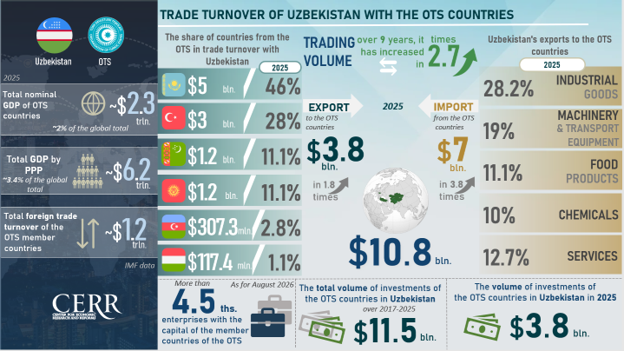
Today, the Organization of Turkic States covers a significant economic space connecting Central Asia, the South Caucasus and Türkiye with European markets. By the end of 2025, the combined nominal GDP of the OTS countries amounted to approximately $2.3 trillion, while their GDP at purchasing power parity exceeded $6.2 trillion. Their aggregate foreign trade turnover surpassed $1.2 trillion.
These figures indicate the presence of a large market for expanding economic cooperation. At the same time, the volume of mutual trade among the OTS countries remains limited relative to their overall economic potential. The next stage of cooperation is therefore increasingly focused on moving beyond the simple expansion of trade toward deeper industrial cooperation, lower transport costs and the financing of joint investment projects.
Differences in the economic structures of the OTS countries provide a foundation for such cooperation. Türkiye has a substantial manufacturing base in machinery, automotive production, electrical engineering, textiles and chemicals. Kazakhstan and Azerbaijan, in addition to their energy resources, hold significant positions in metallurgy and petrochemicals. Uzbekistan is developing its textile and garment industry, electrical engineering, automotive, chemical and food industries, as well as non-ferrous metallurgy. Kyrgyzstan’s capabilities in light industry and agriculture also provide an additional basis for expanding shared production chains.
In this context, the economic outcome of integration within the OTS will increasingly be determined not merely by the volume of mutual trade, but also by the extent to which enterprises in member countries become integrated into one another’s production chains.
Uzbekistan’s Trade with OTS Countries
For Uzbekistan, economic relations with the Turkic states have become an important component of foreign trade diversification.
In 2025, Uzbekistan’s total foreign trade turnover reached $81.2 billion, including $33.8 billion in exports and $47.4 billion in imports. Among the country’s major trading partners, turnover with Kazakhstan amounted to $5 billion, while trade with Türkiye reached $3 billion.
Kazakhstan and Türkiye alone account for roughly one-tenth of Uzbekistan’s total foreign trade. When economic relations with Kyrgyzstan, Turkmenistan, Azerbaijan and Hungary are also taken into account, the OTS space represents a distinct and sizeable regional market for Uzbekistan.
Exports have played an important role in recent trade growth. In 2025, Uzbekistan exported $1.5 billion worth of goods and services to Kazakhstan, $1.1 billion to Türkiye and $771.1 million to Kyrgyzstan.
The composition of trade also points to qualitative changes in economic relations. In 2025, industrial goods accounted for 28.2% of Uzbekistan’s exports to OTS countries, machinery and transport equipment for 19%, food products for 11.1%, chemical products for 10%, and services for 12.7%. On the import side, food products represented 22.8%, mineral fuels 20.3%, industrial goods 18.1%, and machinery and transport equipment 12.9%.
This structure highlights two important features. First, Uzbekistan’s exports to the OTS market are not limited to raw materials, with industrial goods, machinery and equipment accounting for a substantial share. Second, the presence of energy resources, industrial goods and equipment in imports indicates that mutual trade with OTS countries is also closely linked to domestic production processes.
For this reason, alongside trade turnover, the depth of industrial cooperation is becoming an increasingly important indicator of future economic relations.
Untapped Export Potential
Despite significant growth in trade, the available opportunities have yet to be fully utilized.
According to estimates by the Center for Economic Research and Reforms, Uzbekistan has the potential to increase exports to OTS countries by an additional $2.7 billion. The largest reserve is associated with the Turkish market, at $1.8 billion. Additional export potential is estimated at $500 million for Kazakhstan, $200 million for Hungary and $100 million for Kyrgyzstan.
Market size alone, however, is insufficient to ensure export growth. Product quality, mutual recognition of standards, certification procedures, transport costs, delivery times and access to trade finance all directly affect exporters’ competitiveness.
Opportunities are particularly substantial in agriculture and food products. The combined agricultural market of the OTS countries is estimated at around $72 billion. For Uzbekistan, promising export categories include fruit and vegetables, processed food products, textiles, electrical equipment, construction materials, mineral fertilizers, copper products and polymers.
The concentration of a large share of the export reserve in Türkiye and Kazakhstan is also economically significant. Türkiye offers both a sizeable domestic consumer market and access to European and Mediterranean markets. Kazakhstan, due to its geographical proximity, shared transport networks and production linkages within Central Asia, remains a natural partner for cooperation with Uzbek enterprises.
In this sense, realizing the $2.7 billion export reserve requires a coordinated approach across industrial, logistics and trade policies.
Investment Relations Are Becoming More Institutionalized
Alongside trade, investment flows from OTS countries into Uzbekistan have also increased substantially.
Between 2017 and 2025, investment attracted from OTS countries into Uzbekistan exceeded $11.5 billion. In 2025 alone, investment amounted to $3.8 billion. Türkiye was Uzbekistan’s largest investor among OTS countries, with $2.4 billion. Investment was concentrated primarily in manufacturing, energy, agriculture, construction and logistics.
As of April 2026, Uzbekistan was home to more than 4,500 enterprises with capital participation from OTS countries.
The growing number of such enterprises points to a qualitative shift in economic relations. A trade transaction ends once a product crosses the border, whereas direct investment creates longer-term links between economies through capital, technology, employment, local suppliers and export channels.
The expansion of joint industrial projects within the OTS can therefore provide an additional foundation for further growth in mutual trade.
For example, components produced in one country may be used to manufacture finished goods in another and subsequently exported to a third market. In such a case, trade statistics reflect an underlying integrated production chain. Differences in the specialization of the Turkic economies create opportunities for precisely this type of cooperation.
The Turkic Investment Fund as a New Financial Mechanism
One of the most significant institutional developments in the OTS economic architecture has been the transition of the Turkic Investment Fund to practical operations.
In 2025, its authorized capital was increased from $500 million to $600 million. Uzbekistan’s share amounts to $100 million.
The Fund’s economic significance is not limited to the size of its own capital. Its broader potential lies in using these resources to mobilize financing from other international financial institutions.
On 17 June 2026, the Turkic Investment Fund and the Islamic Corporation for the Development of the Private Sector, part of the Islamic Development Bank Group, signed an agreement on an Islamic co-financing program of up to $50 million. The program is intended to finance small and medium-sized enterprises through local financial institutions in Azerbaijan, Kazakhstan, Kyrgyzstan, Türkiye and Uzbekistan.
Another practical model emerged on 1 July. The Turkic Investment Fund signed an agreement to provide up to $10 million in financing to KMF Bank in Kazakhstan, while the European Bank for Reconstruction and Development committed up to $50 million. The combined resources are intended to expand lending to micro, small and medium-sized enterprises.
These two examples point to an emerging trend. Rather than functioning solely as an institution that directly allocates its own resources, the Fund could develop into a platform for mobilizing international financial resources for projects across the OTS region.
Such an approach could help mobilize investment substantially exceeding the Fund’s own $600 million capital base. This mechanism is particularly relevant for industrial cooperation, transport, energy, digital infrastructure and small business projects.
From a Transport Corridor to an Integrated Logistics System
Transport costs and delivery times remain another major factor affecting trade within the OTS region.
Because Central Asian countries lack direct access to seaports, logistics costs have a significant impact on export competitiveness. In this context, the Trans-Caspian International Transport Route — the Middle Corridor, which runs across the Caspian Sea through Azerbaijan, Georgia and Türkiye toward European markets — is becoming an important infrastructure component of economic cooperation within the OTS.
For Uzbekistan, the importance of this route is increasing with the construction of the China–Kyrgyzstan–Uzbekistan railway. Connecting the new railway with the Caspian route could expand Uzbekistan’s participation in the East–West logistics chain linking China, Central Asia, the Caucasus and Europe.
A modern transport corridor, however, consists of more than roads and railways. Border procedures, permits, customs declarations, consignment notes and cargo tracking systems also affect the time and cost of transportation.
Digitalization has therefore become an important component of OTS transport policy.
The e-Permit electronic permit system is being implemented among the organization’s member states. At the 9th Meeting of OTS Ministers of Transport, held in Bishkek on 23 April 2026, a memorandum was also signed on introducing the e-CMR electronic international consignment note.
At the May summit in Turkistan, the President of Uzbekistan noted that the E-Permit system had been fully launched with OTS member states and proposed linking the Middle Corridor with the China–Kyrgyzstan–Uzbekistan railway, developing a simplified customs corridor, and digitalizing data exchange and cargo tracking processes.
If these mechanisms are integrated into a single system, the OTS region could develop a logistics environment that facilitates both the physical movement of goods and the digital flow of accompanying documents and data.
The economic effects can be measured in concrete terms — shorter border crossing times, lower administrative costs and greater predictability of delivery schedules for exporters.
From Trade to Technological Connectivity
In 2026, another new dimension of OTS economic cooperation became increasingly visible.
On 15 May, the informal summit in Turkistan on “Artificial Intelligence and Digital Development” placed particular emphasis on digital infrastructure, innovative technologies and the practical application of artificial intelligence.
Uzbekistan proposed developing the concept of a “Digital Turkic Corridor”, aimed at connecting data centers across the region through high-speed communication channels.
Additional initiatives included the establishment of a strategic cooperation network in artificial intelligence, the organization of a Technology Forum in Tashkent and broader technological cooperation among participating countries.
There is a clear connection between transport and digital integration. While the Middle Corridor facilitates the movement of goods, the Digital Turkic Corridor could accelerate the movement of data.
As a result, two parallel types of infrastructure may develop across the OTS region — physical and digital.
The first encompasses roads and railways, ports, logistics centers and customs infrastructure. The second includes data centers, telecommunications networks, cloud computing, artificial intelligence infrastructure and digital services.
Their integration could support the expansion of e-commerce, digital logistics, fintech, cross-border services and digital production management.
The Institutional Framework for Economic Integration Is Expanding
Another feature of the changes taking place within the OTS is the emergence of permanent mechanisms for economic cooperation.
While cooperation previously relied largely on summits of heads of state, intergovernmental meetings and bilateral agreements, dedicated mechanisms are now taking shape in finance, transport and the digital economy.
The Turkic Investment Fund is establishing a mechanism for financing investment projects. E-Permit and e-CMR are digitalizing transport documentation. The Digital Turkic Corridor initiative is intended to connect information infrastructure across participating countries.
The economic value of these institutions lies primarily in their ability to complement one another.
The effectiveness of integration will therefore depend not only on reducing trade barriers, but also on developing the broader infrastructure that supports trade.
New Economic Opportunities for Uzbekistan
Developments within the OTS open several avenues for expanding Uzbekistan’s economic cooperation.
The first is access to larger export markets. The estimated $2.7 billion in additional export potential represents a significant reserve relative to existing trade flows.
The second is industrial cooperation. Türkiye’s industrial and technological base, the resources of Kazakhstan and Azerbaijan, and Uzbekistan’s labor resources and expanding manufacturing sector provide conditions for developing complementary production chains.
The third is transport geography. Connecting the China–Kyrgyzstan–Uzbekistan railway with the Middle Corridor could expand Uzbekistan’s transit and logistics opportunities along the East–West axis.
The fourth is access to capital. Co-financing mechanisms involving the Turkic Investment Fund and international financial institutions could provide new sources of financing for the private sector.
The fifth is the digital economy. Integration of data centers, artificial intelligence, e-commerce and digital transport documentation could create conditions for faster growth in trade in services.
At the same time, these opportunities will not automatically translate into economic outcomes. Turning the $2.7 billion export potential into actual exports requires addressing product standards, certification, logistics costs, financing and market access at the level of specific product categories.
Likewise, the economic efficiency of transport corridors should be assessed not by their length or the number of participating countries, but by indicators such as cargo delivery times, transport costs per tonne and waiting times at border crossings.
In investment cooperation, the volume of capital attracted should be considered alongside localization levels, the participation of domestic companies in supply chains, job creation and export revenues.
Ahead of the Ankara Summit
As of September 2026, preparations are under way for the 13th OTS Summit in Ankara. On 8 September, OTS Secretary General Kubanychbek Omuraliev and Turkish Foreign Minister Hakan Fidan discussed the organizational and substantive aspects of the summit as well as its expected outcomes.
The discussions also covered another important document — the OTS Strategy for 2027–2031, which is expected to define the organization’s strategic framework and priority areas for the coming period.
In this context, the Ankara Summit may become an important milestone for the next stage of economic cooperation within the OTS.
The trend of recent years is increasingly clear. While the initial emphasis was largely on expanding trade volumes, economic relations are now becoming more closely linked to investment, transport infrastructure, financial institutions and digital technologies.
For Uzbekistan, the next task is to translate the existing $2.7 billion in additional export potential into actual trade, expand joint production chains with OTS countries, reduce transport costs and use new financial mechanisms to support private-sector projects.
Accordingly, the criteria for assessing economic integration within the OTS are also evolving. Trade turnover and investment volumes remain important indicators, but they are increasingly complemented by delivery times, logistics costs, industrial cooperation, joint projects, digital services and mobilized private capital.
It is this transition — from trade in goods toward an interconnected system of production, transport, finance and digital infrastructure — that increasingly defines the new economic substance of cooperation among the Turkic states.
Latofat Burieva
Center for Economic Research and Reforms
📅 09.10.2026
Uzbekistan news
Political mutual trust in the Central Asian region is transforming into economic capital
Uzbekistan attracts specialists from 16 countries to the anniversary international exhibition “Mining, Metallurgy and Metalworking – MiningMetals Uzbekistan 2026”
Uzbekistan has moved its economic cooperation with the Turkic states into a practical dimension
Akramjon Nematov: Central Asia is increasingly emerging as an independent centre for shaping its own economic and technological agenda
Central Asia Is Shaping Its Own Model of Regional Cooperation
Initiatives of Uzbekistan aimed at Economic Results for the Countries of Central Asia and Azerbaijan
Regular dialogue is the Foundation for addressing common water-related challenges in Central Asia
Uzbekistan and Turkmenistan: A New Stage in the Development of Their Strategic Partnership
11th Tashkent International Biennale of Contemporary Art to be held in the capital of Uzbekistan on October 12–16th
OTS Member States - A Crucial Link in the Eurasian Space
Uzbekistan plays an active role in Economic Integration within the framework of the Organization of Turkic States
CICA opens new horizons for financial cooperation
Aquatherm Tashkent 2026 to Showcase Latest Technologies for Construction and Utility Infrastructure
Uzbekistan is securing its place in the Global Hub for Technological Outsourcing
Digital Cooperation among the Turkic States Towards a Unified Technological Ecosystem
Uzbekistan and Azerbaijan are creating a Hub for Startups, Investors and Talent
UZBEKISTAN AND THE UN: FROM NATIONAL INITIATIVES TO THE GLOBAL AGENDA
The 5th Samarkand Forum on Human Rights to take place on September 28–29th
Uzbekistan's key trading partners participate in CICA
Speech by President Shavkat Mirziyoyev at the solemn ceremony dedicated to the thirty-fifth anniversary of the independence of the Republic of Uzbekistan
Uzbekistan Firmly Establishes Itself as a Stable and Predictable Partner for Long-Term International Business
Changing economic priorities of Uzbekistan reshape its engagement with the CIS
Inaugural Central Asia – Republic of Korea Summit at the highest level opens in Seoul
Uzbekistan and Korea: Advancing Green Energy and New Technologies
Uzbekistan and the Republic of Korea in the Emerging Framework for Cooperation with Central Asia
Tashkent brings together leaders and key deals in Polymer Market of Central Asia
The 1st Republic of Korea–Central Asia Summit: Why This Moment Matters
Uzbekistan – Serbia: A New Geography of Industrial Cooperation
The President of Uzbekistan’s Visit to Serbia: A New Stage in Economic Partnership Between Central Asia and the Balkans
Uzbekistan and the Republic of Korea: From Investment Partnership to Technological Cooperation

-
 Ministry of Foreign Affairs of the Republic of Uzbekistan
 -
 Diplomatic Service of the Ministry of Foreign Affairs
 -
 State Committee for Tourism Development
 -
Ministry of Investments and Foreign Trade of the Republic of Uzbekistan
-
 invest.gov.uz
 -

-

-

-

-

-

-


of Uzbekistan in the Republic
of Latvia
When using the information, a link to www.uzembassy.lv
must be provided.
All rights reserved
Address
Address: Riga c., LV-1010. 11-11 Elizabetes Str., Latvia
Phone: 37167322424
Fax: 37167322306
Email: embassy@uzbekistan.lv
Useful links
HomeIssuance of biometric passport for departure abroad
Certificate to return to Uzbekistan
Withdrawal of citizenship
Loss of citizenship