Phone
Consular Issues
Phone
Uzbekistan news
Business in Uzbekistan are moving from digitalization to technological modernization
Center for Economic Research and Reforms (CERR), jointly with the Chamber of Commerce and Industry (CCI), surveyed more than 5,000 entrepreneurs from all regions of the country.
Study assesses the business environment and the effectiveness of entrepreneurship support measures, while developing proposals to further improve business conditions and promote private sector development.
Private businesses accounted for the majority of respondents (93%). By type of activity, wholesale and retail trade had the largest representation (43%), followed by services (30%), industry (17%), construction (8%), and agriculture, forestry and fisheries (2%).
The sample covers enterprises with varying levels of business experience. Almost one in four has been operating for more than 10 years (24%), more than a quarter for 5–10 years (28%), around a quarter for 3–5 years (26%), and one in five for 1–3 years (20%).
Survey results show that enterprises use a variety of tools to improve efficiency. One in three enterprises has adopted several digital solutions (33%), a comparable share uses artificial intelligence in at least two areas (30.4%), and almost one in four applies energy-saving solutions (23.2%). Enterprises are also introducing new products and technologies and revising their production and business processes to reduce costs.
Combined use of several measures is associated with stronger business performance. Among companies that have implemented at least three efficiency improvement measures, more than half report increased demand for their products and services (54.1%). Such enterprises are 4.1 times more likely to reduce costs, while the share of companies recording wage growth of more than 10% is 2.1 times higher.
Enterprises that have implemented at least three efficiency improvement measures also demonstrate greater investment activity, with more than half planning to increase investment in the following year (57.8%).
However, the comprehensive application of efficiency improvement tools has not yet become widespread. Approximately one in nine enterprises has implemented three or more measures (11.6%), while more than a quarter use none of the measures examined (28.5%).
By sector, three or more measures are implemented by 13% of enterprises in both industry and services, followed by trade (11%), construction (9%), and agriculture (8%). Regional differences are more pronounced. The comprehensive set of measures is most widely applied in Tashkent city (18%), while the corresponding figures are considerably lower in the Samarkand (4%), Bukhara (3%), and Syrdarya (2%) regions.
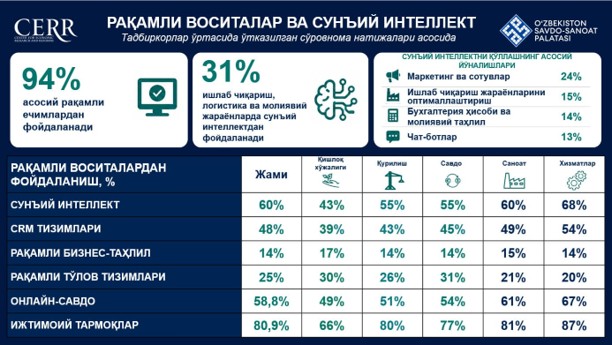
The survey results indicate the widespread use of basic digital solutions among enterprises (94%).
More than half of enterprises use artificial intelligence in one form or another (60%). AI is most commonly applied in marketing and sales (24%), production process optimization (15%), accounting and financial analysis (14%) and chatbots (13%).
At the same time, around one-third of enterprises use AI directly in production, logistics and financial processes (31%), indicating considerable scope for its further practical application.
Almost every second enterprise uses customer relationship management systems (CRM) to organize sales and customer engagement (48%). CRM systems are most widely used in the services sector (54%). Digital business analytics tools are used by only one in seven enterprises (14%). Nearly half of private enterprises do not use such systems, while more than a quarter are unaware of these digital solutions.
Social media has become a standard channel for promotion and customer engagement for more than four out of five enterprises (80.9%). More than half of enterprises have established online sales (58.8%), although the share of enterprises selling more than half of their products online remains relatively small (9%). Digital payment systems are used by one in four enterprises (25%).
The sectoral breakdown reveals differences in how digital tools are used. In services, CRM systems are the most widely used (54%), while this sector also records the highest adoption rates for artificial intelligence (68%), online sales (67%), and social media (87%).
In industry, CRM systems (49%) and artificial intelligence (60%) are widely used, alongside online sales (61%) and social media (81%).
In trade, digital payment systems are relatively more widespread (31%). More than half of enterprises also use artificial intelligence (55%) and online sales (54%), while over three-quarters use social media (77%).
In construction, social media is the most widely used digital tool (80%). More than half of enterprises use artificial intelligence (55%) and online sales (51%), while 43% use CRM systems.
In agriculture, digital payment systems are relatively widespread (30%). At the same time, 43% of enterprises use artificial intelligence, 49% have established online sales, and 66% use social media.
Findings show that further opportunities to improve enterprise efficiency are associated with the broader adoption of modern technologies and management solutions, the modernization and automation of production, development of digital sales channels and improvements in energy efficiency.
The stronger performance of enterprises that use these tools comprehensively demonstrates the importance of their consistent adoption for productivity growth and greater investment activity.
Technological modernization represents a separate area of opportunity for enterprises. The survey results indicate a relationship between the introduction of new products and technologies, increased demand and investment activity.
At the same time, 51% of enterprises still have scope for further technological modernization through upgrades and the introduction of new products, services and innovations.
The further spread of digital solutions also depends on the conditions for their implementation. According to entrepreneurs, digitalization could be supported by improved internet infrastructure (13%), greater availability of qualified specialists (10%) and lower financial costs associated with technology adoption (9%).
The need for skilled personnel is also confirmed by the broader findings of the study, with enterprises reporting shortages of specialists with various qualifications, including IT professionals and engineering and technical personnel.
Overall, the survey results show that further improvements in business efficiency require a transition from the use of individual digital tools to their direct integration into production and management.
CERR’s findings are consistent with the results of World Bank research. Enterprise-level data show that the most significant productivity gains occur when companies move beyond basic access to digital technologies and adopt more advanced solutions, including cloud services, management systems, analytics, and artificial intelligence. Digital payments and online sales alone have a limited impact unless accompanied by changes in internal business processes.
Realizing the considerable untapped potential for technological modernization depends primarily on developing managerial and digital competencies, training qualified personnel, and shifting from supporting access to technologies toward their practical adoption by enterprises.
This approach is also consistent with contemporary research on economic growth, which links long-term productivity gains to the diffusion of new knowledge and its practical application (2025 Nobel Prize in Economic Sciences; Joel Mokyr, Philippe Aghion and Peter Howitt).
Accordingly, further business support measures should focus on expanding the practical adoption of technologies in enterprises’ production and management processes.
Dunyo IA
📅 20.08.2026
Uzbekistan news
Business in Uzbekistan are moving from digitalization to technological modernization
Uzbekistan and Serbia expand prospects for cooperation in ecology and environmental protection
SCO AND WATER DIPLOMACY: IN PURSUIT OF COMMON INTERESTS
TASHKENT-DELHI: A NEW STAGE OF STRATEGIC PARTNERSHIP
On September 4–6th, Samarkand will host XII Inter-Parliamentary Union Global Conference of Young Parliamentarians
The Infrastructure Already Linking Uzbekistan and Korea What Korea Has Already Built Inside Uzbekistan's Digital Economy From Fiber Optics to AI: The Scope of Uzbek-Korean Digital Cooperation The Digital Bridge Already Built Between Uzbekistan and South Korea
On September 8–10th, Tashkent to gather International Textile Industry Professionals
New Uzbekistan: A Builder of Peace and Trust
‘Mustaqillik’ Generation: New Navigators of the Silk Road
GLOBAL COMPETITION AND NEW PEACE DIPLOMACY: THE VOICE OF ENLIGHTENMENT OF NEW UZBEKISTAN IN THE GLOBAL ARENA
SCO AND WATER DIPLOMACY: IN PURSUIT OF COMMON INTERESTS
Uzbekistan’s Dialogue with Business: Five Years of Change
ON THE STATUS OF THE HOST COUNTRY AND A NEW PHASE OF INTERNATIONAL CULTURAL COOPERATION
Transport and Logistics Cooperation Between Uzbekistan and the US: A New Stage of Strategic Partnership
Reforms and Active Dialogue in Entrepreneurship: The President's 6th Open Dialogue as a Catalyst for New Economic Growth
How China–Kyrgyzstan–Uzbekistan railway is redrawing the economic map of the continent
G20 and Uzbekistan: Investment, Industry and Trade in a New Economic Reality
CULTURE — THE TREE OF A NATION'S TRUST UZBEKISTAN — THE UNITED STATES
Uzbekistan and Kyrgyzstan: A New Stage and Future Prospects for Environmental Cooperation
Uzbekistan–Azerbaijan: Environmental cooperation emerges as a key pillar of the strategic partnership
Samarkand hosted an international scientific and practical conference on “Brother Cities: A New Model for Sustainable Development and Public Diplomacy”
Uzbekistan and Kyrgyzstan: Strategic Partnership, Institutionalization, and Mechanisms of Cooperation
Uzbekistan–Kyrgyzstan: From Border Neighbourhood to Long-Term Economic Cooperation
Uzbekistan and Kyrgyzstan: Transitioning to Joint Value Chains
Towards a Unified Intellectual Space of the Turkic World: A New Era of Scientific Integration in the Renaissance Age
Uzbekistan – Kyrgyzstan: Prospects for Cooperation on Water Resources
Central Asia and Azerbaijan: Prospects for a Common Transport Area
Central Asia and Azerbaijan Are Emerging as a Shared Hub for Startups, Investors, and Talent
Uzbekistan - Azerbaijan: economy of trust, routes and joint projects
Uzbekistan - Kyrgyzstan: from border neighborhood to long-term economic cooperation

-
 Ministry of Foreign Affairs of the Republic of Uzbekistan
 -
 Diplomatic Service of the Ministry of Foreign Affairs
 -
 State Committee for Tourism Development
 -
Ministry of Investments and Foreign Trade of the Republic of Uzbekistan
-
 invest.gov.uz
 -

-

-

-

-

-

-


of Uzbekistan in the Republic
of Latvia
When using the information, a link to www.uzembassy.lv
must be provided.
All rights reserved
Address
Address: Riga c., LV-1010. 11-11 Elizabetes Str., Latvia
Phone: 37167322424
Fax: 37167322306
Email: embassy@uzbekistan.lv
Useful links
HomeIssuance of biometric passport for departure abroad
Certificate to return to Uzbekistan
Withdrawal of citizenship
Loss of citizenship