Phone
Consular Issues
Phone
Uzbekistan news
TERMEZ DIALOGUE: FROM CULTURAL-HUMANITARIAN TIES TO BUILDING A SUSTAINABLE REGIONAL ARCHITECTURE
The crises observed today in the system of international relations once again testify to the growing need for mutual understanding, unity, and the achievement of common goals for the states of Central and South Asia. In this regard, dialogue platforms that contribute to strengthening mutual understanding and trust are of particular importance. In this context, the Termez Dialogue serves as a platform for developing interregional cooperation. Its first meeting took place on May 19, 2025, aimed at strengthening regional connectivity and elevating cooperation to a new level.
The growing demand for this platform was reflected in the organization of a separate session dedicated to the Termez Dialogue within the framework of the Doha Forum in December 2025. The discussions highlighted the importance of practical approaches to enhancing interregional cooperation.
The current meeting of the Termez Dialogue is aimed at defining a new stage in the development of the platform - the transition from conceptual discussions to defining priority areas and practical mechanisms for realizing the potential of interregional cooperation. During the Termez Dialogue, special emphasis is expected to be placed on strengthening cultural ties.
This is relevant because interdependence must be understood more broadly than just trade, infrastructure, and transport corridors. It includes social, intellectual, and cultural ties that unite the communities of the region. Revisiting this history creates an important conceptual foundation for modern regional cooperation.
It is noteworthy that even in the past, Termez, a city located between the Greco-Bactrian, Kushan kingdoms, and other ancient states where Zoroastrianism, Buddhism, Christianity, and Islamic traditions emerged and developed as a center of intercultural and religious dialogue, flourished during the Timurid era and became a major center of trade, crafts, and science[1]. Indeed, if we look at our history, the countries of Central Asia and the South Asian region have always developed harmoniously as a single space, closely cooperating in all spheres. The works of the great thinker Abu Rayhan Beruni “India,” Zahiriddin Muhammad Babur “Baburnama” and other historical sources are clear evidence of these close ties.
Furthermore, the following remarks by Muhammad Sobir Turkestani, Deputy Ambassador of Afghanistan to Uzbekistan, deserve attention: “Both Uzbekistan and Afghanistan are located on the land between two rivers, which was once called Mawarannahr.” There are many similarities in our cultures. The cultural heritage of Alisher Navoi is the wealth of the peoples of Uzbekistan and Afghanistan. The remains of our ancestor Alisher Navoi are in the Herat region. All the minarets built in Herat during the reign of Sultan Husayn Bayqara stand as a single complex. Zahiriddin Muhammad Babur was buried in Kabul. In a complex called Babur's Garden. There are also large cultural museums in Afghanistan. Our antiquities are kept in our museums in Kabul, Herat, and Mazar-i-Sharif.”[2] Of course, the main goal of our efforts today is not to develop these historical ties, but to restore them, and to further strengthen the bonds of friendship and brotherhood between our peoples.
To this end, in recent years, Uzbekistan has been increasingly developing ties with the countries of South Asia.
At the same time, special attention is paid to the development of cultural ties and people-to-people contacts, which contributes to strengthening economic ties and realizing untapped potential.
This approach is relevant given the ineffectiveness of using only military-political means to ensure security. For example, the failure to achieve positive results was once again confirmed by the withdrawal of US troops from Afghanistan in 2021, which was carried out with the help of weapons and military to establish peace and stability on Afghan soil. In this context, Uzbekistan's economic ties with Afghanistan today serve as one of the important factors in establishing peace in the country and restoring its economy.
According to estimates by the Statistics Agency of Uzbekistan, mutual trade turnover amounted to $653 million in 2021, $688.8 million in 2022, $784.1 million in 2023, and $999.9 million in January-November 2024[3]. Over the past five years, trade turnover has increased 2.5 times, reaching $1.68 billion in 2025, while Uzbekistan's exports amounted to approximately $1.5 billion. The parties set a new medium-term goal to increase trade turnover to $5 billion. Therefore, today Uzbekistan is becoming one of the important investors in Afghanistan. Specifically, according to a $1 billion agreement signed between Uzbekistan and Afghanistan, Uzbekistan will participate in the development of the Tuti Maidan gas field in the Jauzjan and Faryab regions for 10 years.
The Termez International Trade Center, established in the Surkhandarya region, plays a very important role in implementing such trade and economic instruments. This shopping center is the first trade zone in Central Asia serving various entrepreneurs, especially Afghan entrepreneurs, who cooperate with Afghanistan. The shopping center features permanent exhibitions and fairs, an Uzbek-Afghan business school, a medical clinic for the treatment and provision of medical care to patients who are citizens of Afghanistan, a hotel, enterprises specializing in the production of precious metal jewelry, a multi-currency system, and other conditions that allow entrepreneurs to trade freely.
According to analytical data, 60% of Uzbekistan's total international transport passes through the transit routes of Central Asian countries and Afghanistan. Uzbekistan's access to seaports through Afghanistan is 2-3 times shorter than the access to the Black and Baltic Seas, and 5 times shorter than the route to the Pacific ports[4]. According to economic analysts, the cost of delivering one container from Central Asia to South Asia through Afghanistan to seaports will decrease from $900 to $286. In addition, transportation time will be reduced from 35 days to 3-5 days. At the same time, export potential will also increase sharply. Improving transport and infrastructure communications and attracting international transit carriers to Central Asia is one of the most important tasks uniting the countries of the region. Its resolution is determined by the need to improve the socio-economic situation in the region.
In conclusion, interdependence is the most important task for the countries of Central and South Asia in terms of ensuring stability and sustainable development. In this sense, the Termez Dialogue, as a prestigious international forum, will be effective in further expanding ties between our regions, opening new horizons for cooperation, and moving confidently along the path of peace and development.
Furthermore, the Termez Dialogue, as a platform for strengthening interregional connectivity and restoring common historical, cultural, and civilizational ties, opens opportunities for the development of new international transport and logistics corridors through Afghanistan. In the current difficult conditions of growing mutual trust and conflict of interests, such a format of cooperation as the Termez Dialogue is of great importance.
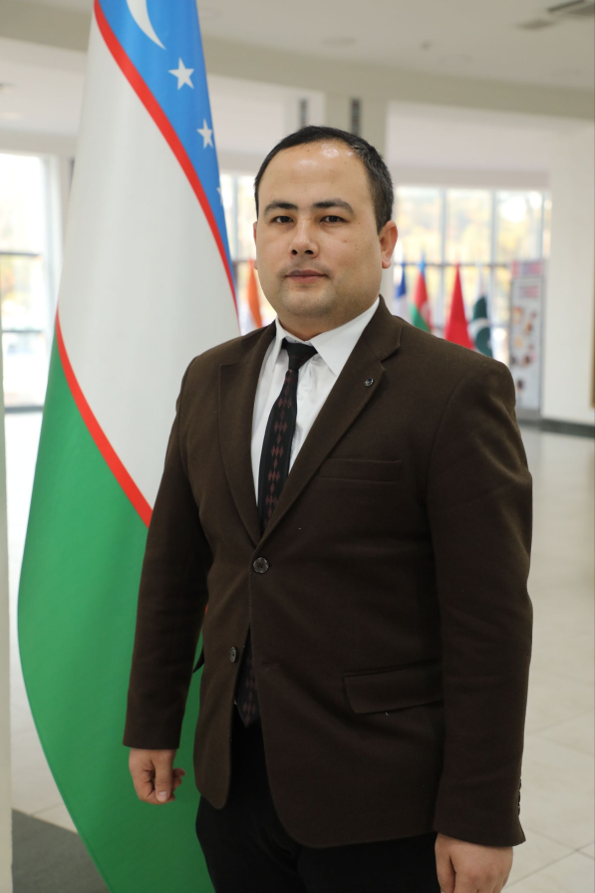
Tashkent State University of Oriental Studies, Foreign policy and international economic relations Deputy Director of the Institute PhD., O. Abdurakhmonov
Eldor Aripov: "Termiz muloqoti Markaziy va Janubiy Osiyo o‘rtasidagi o‘zaro bog‘liqlikni mustahkamlashda muhim ahamiyatga ega". (21.05.2025), https://daryo.uz/2025/05/21/eldor-aripov-termiz-muloqoti-markaziy-va-janubiy-osiyo-ortasidagi-ozaro-bogliqlikni-mustahkamlashda-muhim-ahamiyatga-ega
Afg‘onistonda O‘zbekistonga aloqador madaniy boyliklar kam emas. (07.11.2023). https://xabar.uz/uz/madaniyat/afgonistonda-ozbekistonga-aloqador-madaniy-boyliklar-kam-emas
O‘zbekiston Respublikasi Tashqi savdo aylanmasi. 2024-yil yanvar-noyabr oylari uchun dastlabki ma’lumot // O‘zbekiston Respublikasi huzuridagi Statistika agentligi. – B.4.
Akmalov Sh. O‘zbekiston va Afg‘oniston: o‘tmishdan hozirgacha. Monografiya. – T.: “Zamon poligraf”, 2023. – B. 70.
📅 27.05.2026
Uzbekistan news
Samarkand hosted an international scientific and practical conference on “Brother Cities: A New Model for Sustainable Development and Public Diplomacy”
Uzbekistan and Kyrgyzstan: Strategic Partnership, Institutionalization, and Mechanisms of Cooperation
Uzbekistan–Kyrgyzstan: From Border Neighbourhood to Long-Term Economic Cooperation
Uzbekistan and Kyrgyzstan: Transitioning to Joint Value Chains
Towards a Unified Intellectual Space of the Turkic World: A New Era of Scientific Integration in the Renaissance Age
Uzbekistan – Kyrgyzstan: Prospects for Cooperation on Water Resources
Central Asia and Azerbaijan: Prospects for a Common Transport Area
Central Asia and Azerbaijan Are Emerging as a Shared Hub for Startups, Investors, and Talent
Uzbekistan - Azerbaijan: economy of trust, routes and joint projects
Uzbekistan - Kyrgyzstan: from border neighborhood to long-term economic cooperation
Central Asia and Azerbaijan: Strategic Partners Building a Green Energy Hub Together
Through the Caspian to New Markets
Uzbekistan embraces the language of international law and becomes part of the global financial system
On July 24–25, Samarkand Will Bring Together Global Sister Cities at International Forum
Uzbekistan: An Open and Safe Destination Recognized by the International Community
Green Economy, Social Sustainability, and Transparent Governance: Uzbekistan’s New Development Formula
The text of the appeal of the participants of the first international forum of Islamic civilization to the head of State
Declaration adopted by the participants of the First International Islamic Civilization Forum
Uzbekistan–Belarus economic cooperation: promising projects in the Agri-food sector
Uzbekistan and Belarus: Stable Partnership and Strategic Development Prospects
Uzbekistan and Belarus strengthen multifaceted partnership based on mutual trust and pragmatic cooperation
Areas of Cooperation between Belarus and Uzbekistan in Strengthening Sustainable Transport Corridors in Eurasia
Uzbekistan–Belarus economic cooperation: promising projects in the Agri-food sector
Uzbekistan and Georgia: From historical friendship to a strategic partnership
Uzbekistan–Georgia Relations: Contemporary Priorities for Bilateral Development
Ecological cooperation between Uzbekistan and the United States elevated to the level of a strategic partnership
Cooperation Between Uzbekistan and Georgia in Strengthening Connectivity in Central Asia and the South Caucasus
Uzbekistan as an Operational Hub for Technology Companies: Key Figures, Conditions, and Advantages
“O'zbek futboli” – A Documentary Chronicle of a Century-Long Journey Toward the Nation’s Greatest Football Dream
GENDER POLICY IN UZBEKISTAN

-
 Ministry of Foreign Affairs of the Republic of Uzbekistan
 -
 Diplomatic Service of the Ministry of Foreign Affairs
 -
 State Committee for Tourism Development
 -
Ministry of Investments and Foreign Trade of the Republic of Uzbekistan
-
 invest.gov.uz
 -

-

-

-

-

-

-

of Uzbekistan in the Republic
of Latvia
When using the information, a link to www.uzembassy.lv
must be provided.
All rights reserved
Address
Address: Riga c., LV-1010. 11-11 Elizabetes Str., Latvia
Phone: 37167322424
Fax: 37167322306
Email: embassy@uzbekistan.lv
Useful links
HomeIssuance of biometric passport for departure abroad
Certificate to return to Uzbekistan
Withdrawal of citizenship
Loss of citizenship