Phone
Consular Issues
Phone
Uzbekistan news
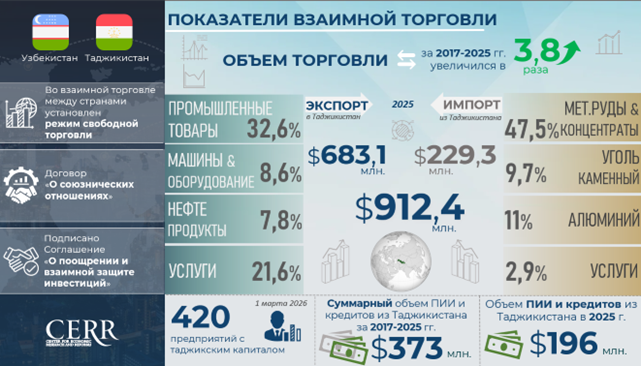
Infographics: Trade, Economic and Investment Cooperation between Uzbekistan and Tajikistan
The Center for Economic Research and Reforms (CERR) has prepared an infographic presenting key indicators of trade, economic and investment cooperation between Uzbekistan and Tajikistan over a nine-year period.
In recent years, economic cooperation between Uzbekistan and Tajikistan has been steadily expanding, now encompassing not only trade but also industrial cooperation across various sectors, particularly energy and agriculture.
A solid legal framework has been established to support bilateral cooperation across multiple areas. In 2018, the countries signed a Treaty on Strategic Partnership, followed by a Treaty on Allied Relations in 2024.
Tajikistan is among Uzbekistan’s key trade and economic partners, ranking 9th among importers of Uzbek goods and accounting for 2% of Uzbekistan’s total exports.
Bilateral trade between Uzbekistan and Tajikistan is conducted under a free trade regime, with total trade turnover approaching $1 bn.
Bilateral Trade Indicators
Trade turnover between Uzbekistan and Tajikistan increased 3.8 times over 2017–2025, from $237.9 mln to $912.4 mln. Exports grew 3.7 times, from $186.1 mln to $683.1 mln, while imports rose 4.4 times, from $51.8 mln to $229.3 mln. Uzbekistan’s positive trade balance expanded 3.4 times, from $134.3 mln to $453.8 mln.
In 2025, compared to 2024, trade turnover increased by 29.9%, exports by 24.1%, and imports by 13.8%.
The structure of Uzbekistan’s exports to Tajikistan in 2025 totaled $683.1 mln and included: industrial goods (various knitted and felt products, plastic products, rolled metal, etc.) – $222.7 mln (32.6%); machinery and transport equipment (including electrical goods) – $58.7 mln (8.6%); petroleum products (gasoline, gas oil, bitumen) – $53.1 mln (7.8%); chemical products (polymers, sulfates, silicates, fertilizers, paints) – $53 mln (7.8%); food products (animal feed, eggs, confectionery, processed meat products, etc.) – $48.2 mln (7.1%); miscellaneous manufactured goods (construction materials, ready-made garments, silk fabrics) – $21 mln (3.1%); non-food raw materials– $8.1 mln (1.2%); other goods (including goods traded by individuals) – $70.1 mln (10.3%); as well as services (mainly railway transport) – $147.4 mln (21.6%).
The structure of imports from Tajikistan in 2025 totaled $229.3 mln and included: metal ores and concentrates (zinc, copper and precious metals) – $108.9 mln (47.5%); coal – $22.3 mln (9.7%); aluminum – $25.4 mln (11%); electricity – $17.9 mln (7.8%); cotton fiber – $17.6 mln (7.8%); fruits – $7.4 mln (3.2%); ferrous metals – $5.1 mln (2.2%); poultry — $2.4 mln (1.1%); plastic waste – $1.8 mln (0.8%); sulfur, feldspar and others; as well as services (mainly railway transport) – $6.6 mln (2.9%).
Investment Cooperation
As of March 1, 2026, there are 420 enterprises in Uzbekistan with Tajik investment (2.2% of the total number of enterprises with foreign investment), including 110 joint ventures and 310 enterprises with 100% Tajik capital.
In 2025, compared to 2024, the volume of foreign direct investment (FDI) and loans attracted from Tajikistan tripled, increasing from $64 mln to $196 mln. Over 2017–2025, the total volume of attracted FDI and loans from Tajikistan amounted to $373 mln.
The main areas of activity of enterprises with Tajik capital include trade, construction materials production, food industry, transport and other services.
Enterprises with Uzbek investment are also successfully operating in Tajikistan. In particular, major joint projects are being implemented in the energy sector, including the construction of hydropower plants on the Zarafshan River. With the participation of private capital from Uzbekistan, the joint venture “Artel Avesto Electronics” was established in Tajikistan in 2019, producing more than 10 types of household appliances.
Prospects for Trade Expansion
Uzbekistan and Tajikistan share a common border and have well-developed transport infrastructure. Given the short delivery distances, transportation costs can be relatively low, which creates favorable conditions for expanding exports.
In this context, Tajikistan represents a promising market for increasing exports of finished products from Uzbekistan that are not produced domestically in Tajikistan and are imported. These include automobiles, household appliances—especially large-sized goods such as refrigerators, washing machines and air conditioners—as well as certain food products, textiles, chemical and other goods.
📅 25.03.2026
Uzbekistan news
BRIGHT PROSPECTS FOR MUTUALLY BENEFICIAL PARTNERSHIP
Transport and Logistics Connectivity of the SCO Amid Geopolitical Turbulence: New Opportunities for the Regions
Business in Uzbekistan are moving from digitalization to technological modernization
Uzbekistan and Serbia expand prospects for cooperation in ecology and environmental protection
SCO AND WATER DIPLOMACY: IN PURSUIT OF COMMON INTERESTS
TASHKENT-DELHI: A NEW STAGE OF STRATEGIC PARTNERSHIP
On September 4–6th, Samarkand will host XII Inter-Parliamentary Union Global Conference of Young Parliamentarians
The Infrastructure Already Linking Uzbekistan and Korea What Korea Has Already Built Inside Uzbekistan's Digital Economy From Fiber Optics to AI: The Scope of Uzbek-Korean Digital Cooperation The Digital Bridge Already Built Between Uzbekistan and South Korea
On September 8–10th, Tashkent to gather International Textile Industry Professionals
New Uzbekistan: A Builder of Peace and Trust
‘Mustaqillik’ Generation: New Navigators of the Silk Road
GLOBAL COMPETITION AND NEW PEACE DIPLOMACY: THE VOICE OF ENLIGHTENMENT OF NEW UZBEKISTAN IN THE GLOBAL ARENA
SCO AND WATER DIPLOMACY: IN PURSUIT OF COMMON INTERESTS
Uzbekistan’s Dialogue with Business: Five Years of Change
ON THE STATUS OF THE HOST COUNTRY AND A NEW PHASE OF INTERNATIONAL CULTURAL COOPERATION
Transport and Logistics Cooperation Between Uzbekistan and the US: A New Stage of Strategic Partnership
Reforms and Active Dialogue in Entrepreneurship: The President's 6th Open Dialogue as a Catalyst for New Economic Growth
How China–Kyrgyzstan–Uzbekistan railway is redrawing the economic map of the continent
G20 and Uzbekistan: Investment, Industry and Trade in a New Economic Reality
CULTURE — THE TREE OF A NATION'S TRUST UZBEKISTAN — THE UNITED STATES
Uzbekistan and Kyrgyzstan: A New Stage and Future Prospects for Environmental Cooperation
Uzbekistan–Azerbaijan: Environmental cooperation emerges as a key pillar of the strategic partnership
Samarkand hosted an international scientific and practical conference on “Brother Cities: A New Model for Sustainable Development and Public Diplomacy”
Uzbekistan and Kyrgyzstan: Strategic Partnership, Institutionalization, and Mechanisms of Cooperation
Uzbekistan–Kyrgyzstan: From Border Neighbourhood to Long-Term Economic Cooperation
Uzbekistan and Kyrgyzstan: Transitioning to Joint Value Chains
Towards a Unified Intellectual Space of the Turkic World: A New Era of Scientific Integration in the Renaissance Age
Uzbekistan – Kyrgyzstan: Prospects for Cooperation on Water Resources
Central Asia and Azerbaijan: Prospects for a Common Transport Area
Central Asia and Azerbaijan Are Emerging as a Shared Hub for Startups, Investors, and Talent

-
 Ministry of Foreign Affairs of the Republic of Uzbekistan
 -
 Diplomatic Service of the Ministry of Foreign Affairs
 -
 State Committee for Tourism Development
 -
Ministry of Investments and Foreign Trade of the Republic of Uzbekistan
-
 invest.gov.uz
 -

-

-

-

-

-

-

of Uzbekistan in the Republic
of Latvia
When using the information, a link to www.uzembassy.lv
must be provided.
All rights reserved
Address
Address: Riga c., LV-1010. 11-11 Elizabetes Str., Latvia
Phone: 37167322424
Fax: 37167322306
Email: embassy@uzbekistan.lv
Useful links
HomeIssuance of biometric passport for departure abroad
Certificate to return to Uzbekistan
Withdrawal of citizenship
Loss of citizenship