Phone
Consular Issues
Phone
Uzbekistan news
CERR Assesses Economic Activity Across Uzbekistan’s Regions Over Five Years Using Satellite Data
An analysis of nighttime satellite illumination data indicates a strengthening of economic activity across regions and an expansion in the number of territories exhibiting urban-type development.
The Center for Economic Research and Reforms (CERR) applied satellite-based nighttime lights (NTL) data to assess economic activity at the level of regions and cities in Uzbekistan.
The analysis shows that higher light intensity corresponds to higher levels of economic activity and more advanced urban infrastructure.
CERR’s findings demonstrate a high degree of consistency between satellite-based indicators and official statistics. In particular, according to estimates based on NASA nighttime lights data, nominal GDP per capita in Uzbekistan grew by 80.3% in 2020–2025, corresponding to an average annual growth rate of 15.8%, increasing from $2,090 to $3,887 over five years.
For comparison, according to official statistics, GDP per capita increased by 81.8% over the same period, with an average annual growth rate of 16.1%, rising from $2,048 to $3,881.
Economic Activity in Large and Medium-Sized Cities
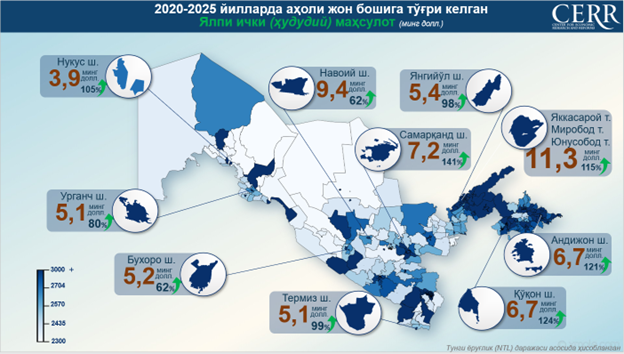
According to the data, over the past five years the highest growth in gross regional product (GRP) per capita among regions was recorded in the city of Tashkent, where the indicator increased by approximately $5,000, reaching $9.3 thousand by the end of 2025 (according to official statistics — $9.2 thousand).
Estimates for 2025 also show high GRP per capita levels in a number of large and medium-sized cities. In Navoi, the NTL-based estimate reached $9.3 thousand, in Zarafshan $7.9 thousand, in Samarkand $7.2 thousand, in Kokand and Andijan $6.7 thousand each, and in Akhangaran, Yangiyul, and Bukhara ranged from $5.8 thousand to $5.2 thousand, respectively.
Relatively high growth rates of GRP per capita were also observed across several regions. In Tashkent region, the indicator increased by $1.8 thousand to reach around $4 thousand. In Navoi region, GRP per capita also grew by $1.8 thousand to approximately $4 thousand. In Fergana and Syrdarya regions, the increase amounted to $1.6 thousand, reaching about $3.5 thousand and $3.4 thousand, respectively.
Economic Activity in Small and Medium-Sized Cities
Relatively high GRP per capita levels were also recorded in a number of small and medium-sized cities. In Termez, the indicator reached $5.1 thousand, in Margilan and Chirchik around $5 thousand, and in Namangan $4.8 thousand. Economic activity levels also remain relatively high in the cities of Kagan and Urgench.
Economic Activity at the District Level
At the district level, the highest GRP per capita growth dynamics in 2020–2025 were observed in Mirabad district, where the indicator increased by $7.1 thousand, in Yakkasaray district by $6.3 thousand, and in Chilanzar district by $5.6 thousand. As a result, GRP per capita in these districts exceeded $10 thousand, which is nearly three times higher than the average across other districts and cities in the country.
Among districts, the highest growth rates of economic activity were also recorded in Karmana district (2.5-fold increase), Yashnabad and Bektemir districts (2.4-fold), as well as Sergeli, Yangi Hayot, and Mirzo Ulugbek districts (2.3-fold).
Expansion of Territories with High Economic Activity
The use of nighttime lights data also made it possible to assess urbanization processes at the district level. In particular, between 2020 and 2025, the number of territories with high nighttime light intensity (NTL above 10), characteristic of urban agglomerations, increased from 22 to 31. The average GRP per capita in these territories rose from $3.8 thousand to $7 thousand.
At the same time, over five years the number of districts with low nighttime light intensity (NTL below 1) declined from 129 to 85, confirming the transition of 44 districts toward an urban-type development model.
In these districts, NTL levels increased on average by more than 2.5 times, while GRP per capita rose from $1.7 thousand to $3.2 thousand.
Conclusion
The results confirm that satellite-based nighttime lights data can effectively complement official statistics and be used for timely assessment of regional economic activity.
This approach enables the identification of new growth points and allows for more targeted allocation of state support toward infrastructure development and investment activity in the regions.
Abdulaziz Gaybullayev, CERR
CERR Public Relations Sector
Tel.: (+998) 78 150-32-20 (417)
📅 25.03.2026
Uzbekistan news
BRIGHT PROSPECTS FOR MUTUALLY BENEFICIAL PARTNERSHIP
Transport and Logistics Connectivity of the SCO Amid Geopolitical Turbulence: New Opportunities for the Regions
Business in Uzbekistan are moving from digitalization to technological modernization
Uzbekistan and Serbia expand prospects for cooperation in ecology and environmental protection
SCO AND WATER DIPLOMACY: IN PURSUIT OF COMMON INTERESTS
TASHKENT-DELHI: A NEW STAGE OF STRATEGIC PARTNERSHIP
On September 4–6th, Samarkand will host XII Inter-Parliamentary Union Global Conference of Young Parliamentarians
The Infrastructure Already Linking Uzbekistan and Korea What Korea Has Already Built Inside Uzbekistan's Digital Economy From Fiber Optics to AI: The Scope of Uzbek-Korean Digital Cooperation The Digital Bridge Already Built Between Uzbekistan and South Korea
On September 8–10th, Tashkent to gather International Textile Industry Professionals
New Uzbekistan: A Builder of Peace and Trust
‘Mustaqillik’ Generation: New Navigators of the Silk Road
GLOBAL COMPETITION AND NEW PEACE DIPLOMACY: THE VOICE OF ENLIGHTENMENT OF NEW UZBEKISTAN IN THE GLOBAL ARENA
SCO AND WATER DIPLOMACY: IN PURSUIT OF COMMON INTERESTS
Uzbekistan’s Dialogue with Business: Five Years of Change
ON THE STATUS OF THE HOST COUNTRY AND A NEW PHASE OF INTERNATIONAL CULTURAL COOPERATION
Transport and Logistics Cooperation Between Uzbekistan and the US: A New Stage of Strategic Partnership
Reforms and Active Dialogue in Entrepreneurship: The President's 6th Open Dialogue as a Catalyst for New Economic Growth
How China–Kyrgyzstan–Uzbekistan railway is redrawing the economic map of the continent
G20 and Uzbekistan: Investment, Industry and Trade in a New Economic Reality
CULTURE — THE TREE OF A NATION'S TRUST UZBEKISTAN — THE UNITED STATES
Uzbekistan and Kyrgyzstan: A New Stage and Future Prospects for Environmental Cooperation
Uzbekistan–Azerbaijan: Environmental cooperation emerges as a key pillar of the strategic partnership
Samarkand hosted an international scientific and practical conference on “Brother Cities: A New Model for Sustainable Development and Public Diplomacy”
Uzbekistan and Kyrgyzstan: Strategic Partnership, Institutionalization, and Mechanisms of Cooperation
Uzbekistan–Kyrgyzstan: From Border Neighbourhood to Long-Term Economic Cooperation
Uzbekistan and Kyrgyzstan: Transitioning to Joint Value Chains
Towards a Unified Intellectual Space of the Turkic World: A New Era of Scientific Integration in the Renaissance Age
Uzbekistan – Kyrgyzstan: Prospects for Cooperation on Water Resources
Central Asia and Azerbaijan: Prospects for a Common Transport Area
Central Asia and Azerbaijan Are Emerging as a Shared Hub for Startups, Investors, and Talent

-
 Ministry of Foreign Affairs of the Republic of Uzbekistan
 -
 Diplomatic Service of the Ministry of Foreign Affairs
 -
 State Committee for Tourism Development
 -
Ministry of Investments and Foreign Trade of the Republic of Uzbekistan
-
 invest.gov.uz
 -

-

-

-

-

-

-


of Uzbekistan in the Republic
of Latvia
When using the information, a link to www.uzembassy.lv
must be provided.
All rights reserved
Address
Address: Riga c., LV-1010. 11-11 Elizabetes Str., Latvia
Phone: 37167322424
Fax: 37167322306
Email: embassy@uzbekistan.lv
Useful links
HomeIssuance of biometric passport for departure abroad
Certificate to return to Uzbekistan
Withdrawal of citizenship
Loss of citizenship