Phone
Consular Issues
Phone
Uzbekistan news
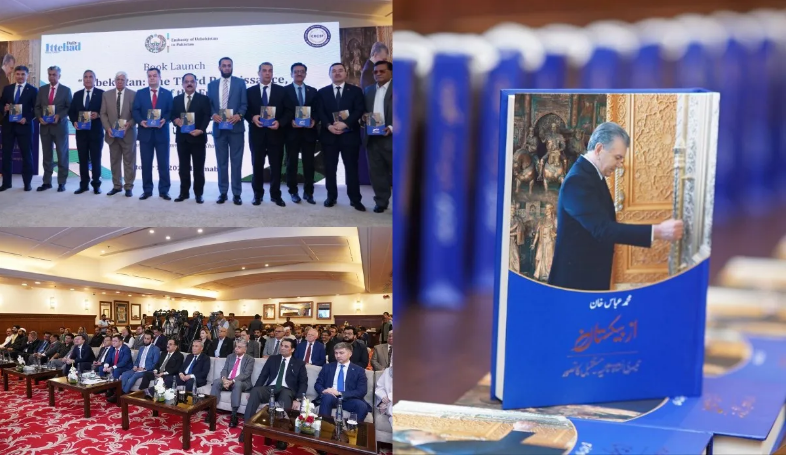
Pakistan hosts presentation of the book – “Uzbekistan: Third Renaissance – Concept of the Future” in Urdu
A presentation of the literary and publicistic collection “Uzbekistan: Third Renaissance – Concept of the Future” was held in Islamabad, written in Urdu by renowned Pakistani journalist and author Muhammad Abbas Khan, explores Uzbekistan’s modern development vision and reform agendat.
The collection offers a comprehensive analysis of the essence, spiritual foundations, and global significance of Uzbekistan’s vision for a New Renaissance — the foundation of the country’s Third Renaissance — under the leadership of President Shavkat Mirziyoyev. The book elaborates on the concept advanced by the Head of State, tracing its historical roots and outlining its relevance for the future of human civilization. The author emphasizes that this vision draws inspiration from the legacy of Uzbekistan’s great ancestors and seeks to unite the principles of modern development, enlightenment, and humanism, serving as a bridge between the nation’s rich intellectual past and its forward-looking aspirations.
The collection also highlights the shared initiatives and common aspirations of the leaders of Uzbekistan and Pakistan to advance major transport and communication projects linking Central and South Asia. According to the author, these efforts represent the revival of the legendary Silk Road. The book not only describes the sweeping reforms and modernization taking place in Uzbekistan, but also emphasizes that the development path of the “New Uzbekistan” may serve as an inspiring model for Pakistan and the wider Eastern world.
The presentation ceremony brought together members of Pakistan’s government and parliament, representatives of the diplomatic corps accredited in Islamabad, prominent scholars, analysts, public figures, and media representatives. Attaullah Tarar, Federal Minister for Information & Broadcasting of Pakistan, attended the event as the guest of honour.
The presentation opened with the national anthems of Uzbekistan and Pakistan, followed by a video highlighting the nine years of Shavkat Mirziyoyev’s leadership as a President of Uzbekistan.
The event commenced with welcoming remarks by Alisher Tukhtaev, Ambassador of Uzbekistan to Pakistan. In his address, the Ambassador emphasized that, under the leadership of President Shavkat Mirziyoyev, Uzbekistan has entered an era of openness and creative transformation.
He noted that over the past nine years, the country has implemented comprehensive reforms across the socio-economic, political, educational, and cultural spheres. As a result, Uzbekistan’s Gross Domestic Product has doubled, reaching 115 billion US dollars; exports have risen to 26 billion dollars; and foreign investments have exceeded 130 billion dollars. Thousands of new enterprises have been established, reflecting the dynamic pace of development and modernization.
It was noted that relations between Uzbekistan and Pakistan have been elevated to the level of a strategic partnership, with the establishment of the High-Level Strategic Cooperation Council. Direct air connections now link Tashkent with Islamabad and Lahore, while collaboration in the fields of education and culture continues to expand rapidly.
Particular attention was given to the Trans-Afghan Railway Project — recognized as a strategic initiative aimed at strengthening peace, mutual trust, and economic connectivity across the region, effectively reconnecting Central and South Asia.
Ambassador Alisher Tukhtaev expressed his sincere gratitude to the author of the featured work, Muhammad Abbas Khan, and to the management of “Daily Ittehad” publishing house for their contribution to the creation and publication of the book. He emphasized that this work will make a valuable contribution to fostering friendship and solidarity between the peoples of Uzbekistan and Pakistan.
In turn, Tahir Farooq, head of “Daily Ittehad” publishing house, expressed his satisfaction with the publication of the book “Uzbekistan: Third Renaissance – Concept of the Future”.
“This book is not merely a compilation of facts about Uzbekistan”, - he noted, - but an important work that vividly reflects the ongoing processes of reform and renewal in the country. It is not a collection of speeches or a translation of another author’s work, but the result of five years of observation and analysis by Muhammad Abbas Khan. His insights carry great significance for understanding Uzbekistan’s contemporary path of development. The book also serves as an important historical document of the new era unfolding in Uzbekistan”.
In his address, Attaullah Tarar, Minister for Information and Broadcasting of Pakistan, highlighted the deep historical ties between the peoples of Uzbekistan and Pakistan, noting that the land of Uzbekistan has produced eminent figures of the Timurid dynasty, including the distinguished scholar and statesman Zahiriddin Muhammad Babur. The Minister emphasized that the region connecting Central and South Asia has always been a vital part of the Great Silk Road, and that Uzbekistan’s contemporary policy under the leadership of President Shavkat Mirziyoyev is focused on revitalizing this historic corridor of cooperation.
Concluding his speech, Minister Attaullah Tarar reaffirmed the readiness of Pakistan’s Ministry of Information and Broadcasting to extend full support in promoting the book and the “Third Renaissance” initiatives advanced by President Shavkat Mirziyoyev to the Pakistani public.
In his address, author Muhammad Abbas Khan discussed the process of writing the book, the ideas it conveys, and its principal objectives. According to the author, the work is based on his research, observations, and personal impressions, providing an objective account of Uzbekistan’s ongoing processes of renewal and development.
“I have had the opportunity to directly observe the profound transformations taking place in Uzbekistan, the reforms being implemented under the leadership of President Shavkat Mirziyoyev, and the policies aimed at fostering an open society, enhancing human dignity, and advancing education and enlightenment, along with their tangible results. Today, Uzbekistan is experiencing a period of awakening. The concept of the Third Renaissance, being realized in Uzbekistan, serves as an example of a universal experience grounded in confidence in the future, scientific and spiritual renewal, and policies for the development of human potential”, - said Muhammad Abbas Khan.
The book “Uzbekistan: Third Renaissance – Concept of the Future” is expected to serve as a unique resource for familiarizing the Pakistani public with Uzbekistan’s new historical path of development, while further strengthening the cultural and spiritual bonds between the two nations.
📅 06.11.2025
Uzbekistan news
BRIGHT PROSPECTS FOR MUTUALLY BENEFICIAL PARTNERSHIP
Transport and Logistics Connectivity of the SCO Amid Geopolitical Turbulence: New Opportunities for the Regions
Business in Uzbekistan are moving from digitalization to technological modernization
Uzbekistan and Serbia expand prospects for cooperation in ecology and environmental protection
SCO AND WATER DIPLOMACY: IN PURSUIT OF COMMON INTERESTS
TASHKENT-DELHI: A NEW STAGE OF STRATEGIC PARTNERSHIP
On September 4–6th, Samarkand will host XII Inter-Parliamentary Union Global Conference of Young Parliamentarians
The Infrastructure Already Linking Uzbekistan and Korea What Korea Has Already Built Inside Uzbekistan's Digital Economy From Fiber Optics to AI: The Scope of Uzbek-Korean Digital Cooperation The Digital Bridge Already Built Between Uzbekistan and South Korea
On September 8–10th, Tashkent to gather International Textile Industry Professionals
New Uzbekistan: A Builder of Peace and Trust
‘Mustaqillik’ Generation: New Navigators of the Silk Road
GLOBAL COMPETITION AND NEW PEACE DIPLOMACY: THE VOICE OF ENLIGHTENMENT OF NEW UZBEKISTAN IN THE GLOBAL ARENA
SCO AND WATER DIPLOMACY: IN PURSUIT OF COMMON INTERESTS
Uzbekistan’s Dialogue with Business: Five Years of Change
ON THE STATUS OF THE HOST COUNTRY AND A NEW PHASE OF INTERNATIONAL CULTURAL COOPERATION
Transport and Logistics Cooperation Between Uzbekistan and the US: A New Stage of Strategic Partnership
Reforms and Active Dialogue in Entrepreneurship: The President's 6th Open Dialogue as a Catalyst for New Economic Growth
How China–Kyrgyzstan–Uzbekistan railway is redrawing the economic map of the continent
G20 and Uzbekistan: Investment, Industry and Trade in a New Economic Reality
CULTURE — THE TREE OF A NATION'S TRUST UZBEKISTAN — THE UNITED STATES
Uzbekistan and Kyrgyzstan: A New Stage and Future Prospects for Environmental Cooperation
Uzbekistan–Azerbaijan: Environmental cooperation emerges as a key pillar of the strategic partnership
Samarkand hosted an international scientific and practical conference on “Brother Cities: A New Model for Sustainable Development and Public Diplomacy”
Uzbekistan and Kyrgyzstan: Strategic Partnership, Institutionalization, and Mechanisms of Cooperation
Uzbekistan–Kyrgyzstan: From Border Neighbourhood to Long-Term Economic Cooperation
Uzbekistan and Kyrgyzstan: Transitioning to Joint Value Chains
Towards a Unified Intellectual Space of the Turkic World: A New Era of Scientific Integration in the Renaissance Age
Uzbekistan – Kyrgyzstan: Prospects for Cooperation on Water Resources
Central Asia and Azerbaijan: Prospects for a Common Transport Area
Central Asia and Azerbaijan Are Emerging as a Shared Hub for Startups, Investors, and Talent

-
 Ministry of Foreign Affairs of the Republic of Uzbekistan
 -
 Diplomatic Service of the Ministry of Foreign Affairs
 -
 State Committee for Tourism Development
 -
Ministry of Investments and Foreign Trade of the Republic of Uzbekistan
-
 invest.gov.uz
 -

-

-

-

-

-

-

of Uzbekistan in the Republic
of Latvia
When using the information, a link to www.uzembassy.lv
must be provided.
All rights reserved
Address
Address: Riga c., LV-1010. 11-11 Elizabetes Str., Latvia
Phone: 37167322424
Fax: 37167322306
Email: embassy@uzbekistan.lv
Useful links
HomeIssuance of biometric passport for departure abroad
Certificate to return to Uzbekistan
Withdrawal of citizenship
Loss of citizenship